

You are using an out of date browser. It may not display this or other websites correctly.
You should upgrade or use an alternative browser.
You should upgrade or use an alternative browser.
A little good news for CA collectors - Leno Law
- Thread starter BMW Pete
- Start date
rblongboarder
Well-Known Member
I'm very naive about this, but I'd like to pose a question:
Is there a legal difference between an officially registered collector vehicle and a daily driver?
According to the article, by 2033, the smog cutoff date with be 1986. That means a lot of E12's, E21's, E23's, E24's, E28's and E30's become potential candidates, along with various Porsche models, and a number of JDM cars.
Is there a legal difference between an officially registered collector vehicle and a daily driver?
According to the article, by 2033, the smog cutoff date with be 1986. That means a lot of E12's, E21's, E23's, E24's, E28's and E30's become potential candidates, along with various Porsche models, and a number of JDM cars.

They have limitations on the mileage and use of the cars. Not sure how they verify that. Here is the general provision: To qualify, vehicles must meet the bill's collector-use requirements, and owners must either carry collector-car insurance or be able to verify the vehicle is driven fewer than 1,000 miles per year.I'm very naive about this, but I'd like to pose a question:
Is there a legal difference between an officially registered collector vehicle and a daily driver?
According to the article, by 2033, the smog cutoff date with be 1986. That means a lot of E23's, E24's, E28's and E30's become potential candidates, along with various Porsche models, and a number of JDM cars.
rblongboarder
Well-Known Member
Here's the LA Times article on this topic (not that they're experts..):

 www.latimes.com
Key sentence: "In order to be eligible, owners must prove that their collector car isn't used for everyday transport either by holding collector-car insurance or documenting that the car is driven fewer than 1,000 miles per year."
Some California cars will get to skip smog checks. What to know about Jay Leno's Law
Gov. Gavin Newsom visited Jay Leno's Burbank garage to sign State Bill 1392, which expands smog check exemptions for certain collector cars.
www.latimes.com
Key sentence: "In order to be eligible, owners must prove that their collector car isn't used for everyday transport either by holding collector-car insurance or documenting that the car is driven fewer than 1,000 miles per year."

I looked at the law. Only a "collector motor vehicle" that is at least 35 model years old qualifies, and a car used primarily for transportation cannot be a collector motor vehicle. LATimes seems to indicate they are going to police this based on what type of insurance you have on the car, which makes sense. Not sure where they got the 1000 miles thing. Its not in the law, and technically, a car driven fewer than 1000 miles a year could be used primarily for transportation and not owned as a collector car. The rule is based on intended use ("shows, parades, charitable functions, and historical exhibitions for display, maintenance, and preservation") and age in model years.

It's simple. Have collectors insurance and drive as much as your insurance allows (Grundy is unlimited) or carry regular insurance (who does that?) and prove the mileage. As your classic insurance already requires, it can't be you primary transport. Nothing additional or onerous there. In Jan 1 2027, the law in Calif changes to allow cars from 1980 and earlier (currently 1975). Every following year another year is added to the exempted vehicles until reaching 1985 MY and then it stops.
My girlfriend and I went to the Capital the day the assembly were voting as there was a bit of a roll call for classics. Here's a picture of Kim and her Bahia Red 1973 911E. Shes obviously outside the range affected by this new law but wanted to show classic car solidarity!
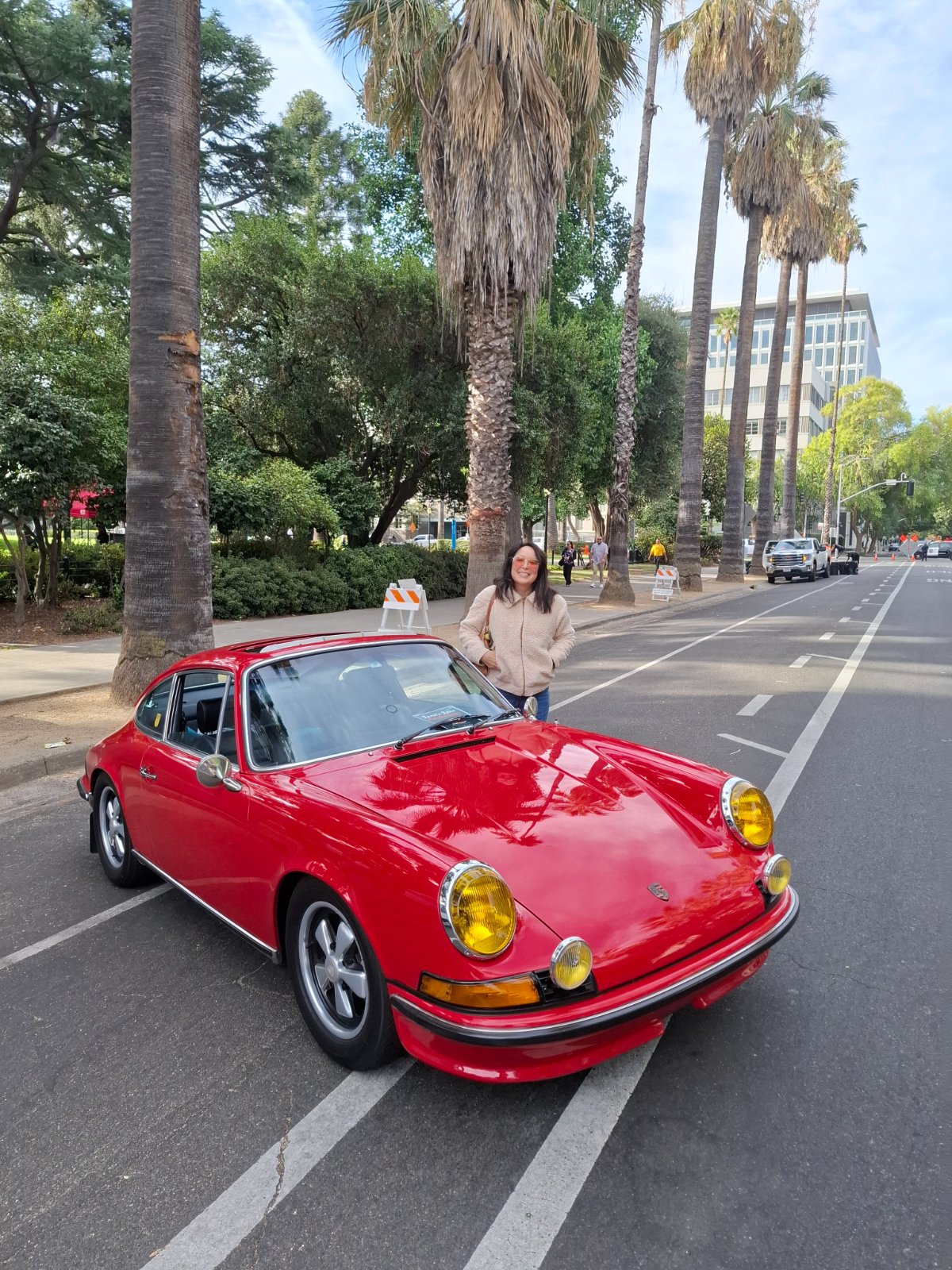
My girlfriend and I went to the Capital the day the assembly were voting as there was a bit of a roll call for classics. Here's a picture of Kim and her Bahia Red 1973 911E. Shes obviously outside the range affected by this new law but wanted to show classic car solidarity!
THAT is a beautiful car!!It's simple. Have collectors insurance and drive as much as your insurance allows (Grundy is unlimited) or carry regular insurance (who does that?) and prove the mileage. As your classic insurance already requires, it can't be you primary transport. Nothing additional or onerous there. In Jan 1 2027, the law in Calif changes to allow cars from 1980 and earlier (currently 1975). Every following year another year is added to the exempted vehicles until reaching 1985 MY and then it stops.
My girlfriend and I went to the Capital the day the assembly were voting as there was a bit of a roll call for classics. Here's a picture of Kim and her Bahia Red 1973 911E. Shes obviously outside the range affected by this new law but wanted to show classic car solidarity!
View attachment 226429
THAT is a beautiful car!!
Thank you, I'll pass along your comment. It's her pride and joy. She ADORES it. It's also the car that brought us together at a Porsche rally 3+ years ago. It's almost perfect with factory sport seats and a 915 5-speed. I was hooked when she told me on our first interaction, that she had purposefully sought out an MFI car.

I think with this Christmas, you should buy her some driving gloves!
Dude... That was two years ago! Red lambskin!I think with this Christmas, you should buy her some driving gloves!
It's simple. Have collectors insurance and drive as much as your insurance allows (Grundy is unlimited) or carry regular insurance (who does that?) and prove the mileage. As your classic insurance already requires, it can't be you primary transport. Nothing additional or onerous there. In Jan 1 2027, the law in Calif changes to allow cars from 1980 and earlier (currently 1975). Every following year another year is added to the exempted vehicles until reaching 1985 MY and then it stops.
My girlfriend and I went to the Capital the day the assembly were voting as there was a bit of a roll call for classics. Here's a picture of Kim and her Bahia Red 1973 911E. Shes obviously outside the range affected by this new law but wanted to show classic car solidarity!
View attachment 226429
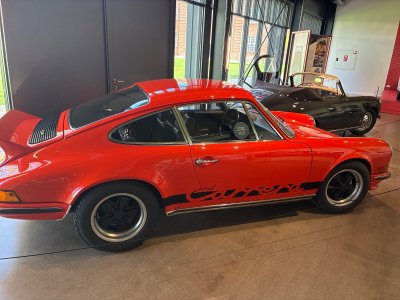
And here is Tangerine Red!
Attachments


Yes, I looked at it as well, and agree, in the actual wording of the law there is nothing that limits the mileage. The news articles seems to suggest that cars which are either (1) driven less than 1000 miles per year or (2) are insured as collector vehicles qualify, but the actual law states that it MUST be registered as collector vehicle. The 1000 mile limitation doesn't make much sense, as the Pebble Beach tour that begins in Seattle and drives down to Pebble Beach for the start of the Concours would essentially disqualify every single one of those vehicles.
See below:
owned by a collector, as defined in subdivision (a) of Section 5051, and the motor vehicle is used primarily in shows, parades, charitable functions, and historical exhibitions for display, maintenance, and preservation, and is not used primarily for transportation. that meets all of the following criteria:
(a) Is at least 35 model years old.
(b) Is used primarily in shows, parades, charitable functions, and historical exhibitions for display, maintenance, and preservation, and is not used as the owner’s primary mode of transportation.
(c) Is insured as a collector motor vehicle with proof of insurance submitted to the department at the time of registration.
Washington state just enacted a slight variation of this, which is that in order to obtain collectible vehicle plates, the car must be over 30 years old AND (the new part) you need to show proof of another vehicle registered under your name that isn't a collectible, essentially to demonstrate that it's not your daily driver.
Along the same lines, for those of us with Hagerty or other insurance, although it's intended primarily for travel to shows, events, etc rather than standard weekly cruising, it does include a line about "assessing mechanical integrity", so IF someone ever complained about the fact that I drove my wife and I around town for pleasure on a sunny Seattle Sunday, my answer would be "I adjusted XYZ this morning and just need to make sure it's all working OK"
See below:
259.
“Collector motor vehicle” means a motor vehicle(a) Is at least 35 model years old.
(b) Is used primarily in shows, parades, charitable functions, and historical exhibitions for display, maintenance, and preservation, and is not used as the owner’s primary mode of transportation.
(c) Is insured as a collector motor vehicle with proof of insurance submitted to the department at the time of registration.
Washington state just enacted a slight variation of this, which is that in order to obtain collectible vehicle plates, the car must be over 30 years old AND (the new part) you need to show proof of another vehicle registered under your name that isn't a collectible, essentially to demonstrate that it's not your daily driver.
Along the same lines, for those of us with Hagerty or other insurance, although it's intended primarily for travel to shows, events, etc rather than standard weekly cruising, it does include a line about "assessing mechanical integrity", so IF someone ever complained about the fact that I drove my wife and I around town for pleasure on a sunny Seattle Sunday, my answer would be "I adjusted XYZ this morning and just need to make sure it's all working OK"
One thing all of these rules miss is that cars deteriorate if not driven regularly. My car is still used primarily for recreation even though I exercise it regularly.Yes, I looked at it as well, and agree, in the actual wording of the law there is nothing that limits the mileage. The news articles seems to suggest that cars which are either (1) driven less than 1000 miles per year or (2) are insured as collector vehicles qualify, but the actual law states that it MUST be registered as collector vehicle. The 1000 mile limitation doesn't make much sense, as the Pebble Beach tour that begins in Seattle and drives down to Pebble Beach for the start of the Concours would essentially disqualify every single one of those vehicles.
See below:
259.
“Collector motor vehicle” means a motor vehicleowned by a collector, as defined in subdivision (a) of Section 5051, and the motor vehicle is used primarily in shows, parades, charitable functions, and historical exhibitions for display, maintenance, and preservation, and is not used primarily for transportation.that meets all of the following criteria:
(a) Is at least 35 model years old.
(b) Is used primarily in shows, parades, charitable functions, and historical exhibitions for display, maintenance, and preservation, and is not used as the owner’s primary mode of transportation.
(c) Is insured as a collector motor vehicle with proof of insurance submitted to the department at the time of registration.
Washington state just enacted a slight variation of this, which is that in order to obtain collectible vehicle plates, the car must be over 30 years old AND (the new part) you need to show proof of another vehicle registered under your name that isn't a collectible, essentially to demonstrate that it's not your daily driver.
Along the same lines, for those of us with Hagerty or other insurance, although it's intended primarily for travel to shows, events, etc rather than standard weekly cruising, it does include a line about "assessing mechanical integrity", so IF someone ever complained about the fact that I drove my wife and I around town for pleasure on a sunny Seattle Sunday, my answer would be "I adjusted XYZ this morning and just need to make sure it's all working OK"