tranny tunnel thermal insulation

rsporsche

Moderator
Site Donor $$
Messages
13,236
Reaction score
5,877
Location
Atlanta, GA
hey guys, curious about the experience of using thermal insulation on the tranny tunnel such as dynaliner or dynacore ... in particular, the thickness (1/4" or 1/2") and not impact a/c + console installation. i would like the thermal insulating value of the 1/2" but i am very concerned about impact to installation. i am going to use 1/2" on the floors and firewall ... and will probably put it on the inside of the door skins. dynacore talks about being flexible and compressible which sounds great - curious if it lives up to that in reality. dynaliner does not talk about being compressible
 
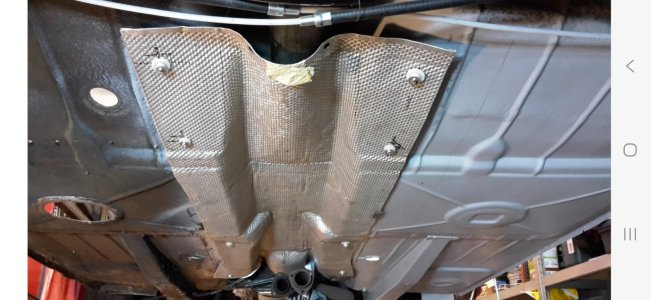
Scott - I used a different product, so I can't comment directly on your question. But I wanted to add that I added a modified Z3 heat shield underneath the car bewteen the exhaust and the driveshaft, using the tranny mount to secure the front of the shield, longer bolts for the driveshaft center bearing in the middle, and zip ties on the end. I got some grief here for the zip ties, but they work well in this application.
 
I too used a different product, paint on thermal barrier, adhesive thermal barrier and then substantial padding. It was still very hot. I ended up adding a thermal barrier on top of the exhaust and that helped a lot.
 
Engineering wise you just can't beat a shield under your floor. More work?
Perhaps. If you consider the work to make sure that interior fittings /console installation still need to fit? Not soo much (is my guess)

In my build thread is a section on heat shield fabrication.

Anything on the inside means that the heat is already soaked up into the metal. If you then cover the top (interior) it'll "just" spread to the side where you didn't shield it, and radiate into the cabin at the edges.
Secondly, layers laid on top of the floor are by definition in contact allowing heat conduction. The airgap created when using a heat shield underneath forces the heat to radiate from shield to floor (jump the airgaps), which is just a slower rate of energy transmission. On top of that; the heatshield (literally) there's also cooling due to airflow.
 
Scott we used the 1/2” dynaPad, it worked well but was a little tight making it fit back together.

IMG_3027.jpeg
 
As @eriknetherlands stated;

If you are trying to reduce radiated heat from exhaust/bellhousing - it falls as an inverse square function of the distance from the source. Therefore, metal shield under the floor and close the source is the always best answer.

Convected heat from, say a hot floor does not follow inverse law but just distance. So you can additionally, use something inside the floor like a dynamat.

The cabin will be so cool that you will need heated seats! :)
 
i have been planning to do something for a heat shield above the exhaust, just haven't got there yet. will probably do that when we do work under the car - swapping out the rear subframe / brakes.
 
As usual, I spend time here and it costs me money. I have a brand-new exhaust system which I’ll install but hadn’t thought about this added option. I too will likely add the heat shielding, seems like not too much work/cost for some benefit
 
i have a Stahl header on the car, it was ceramic coated and that will reduce the heat through that portion of the exhaust - i will have the e28 heat shield above the header (under the passenger floor). where it turns and goes into the tunnel is somewhere behind the shift platform ... so right about where the console ends. that is the place where the heat shield should start.
 
i have been planning to do something for a heat shield above the exhaust, just haven't got there yet. will probably do that when we do work under the car - swapping out the rear subframe / brakes.
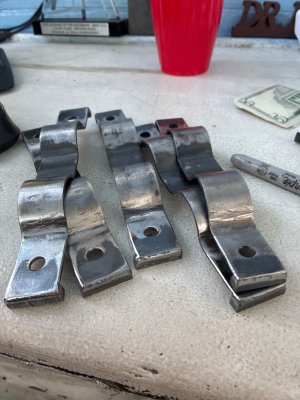
I have a limited amount of the Bows that hold the heat shield above the Center muffler onto the pipes available that I had made part number three on the ETK
 

Attachments

  • image.jpg
    image.jpg
    616 KB · Views: 15
Engineering wise you just can't beat a shield under your floor. More work?
Perhaps. If you consider the work to make sure that interior fittings /console installation still need to fit? Not soo much (is my guess)

In my build thread is a section on heat shield fabrication.

Anything on the inside means that the heat is already soaked up into the metal. If you then cover the top (interior) it'll "just" spread to the side where you didn't shield it, and radiate into the cabin at the edges.
Secondly, layers laid on top of the floor are by definition in contact allowing heat conduction. The airgap created when using a heat shield underneath forces the heat to radiate from shield to floor (jump the airgaps), which is just a slower rate of energy transmission. On top of that; the heatshield (literally) there's also cooling due to airflow.
The early E12 based E24 has a heat shield in that area that could probably be adapted to fit. Item 20 in
Screenshot 2026-03-11 at 9.21.45 PM.png
the diagram below.
 
Last edited:
I got one (the?) E24 part : didn't fit.

I went for the e60 /e61 heat shield, but hammered it into shape over a wooden buck.
View attachment 216767

Post in thread 'Fixing that little rust spot...' https://e9coupe.com/forum/threads/fixing-that-little-rust-spot.18521/post-194504
you should have saved the form and started a cottage industry. bet you could sell a bunch of these Erik ... i looked on realoem and the heat shield on the e60 / e61 ... the part number appears to be 51487033723 - yikes its 175 bucks. a while back i bought one from an e28 - 51481881581 ( it is NLA though).

 
Last edited:
Back
Top