
I did go for the new BOSCH and have put the rebuild as a DIY into my winter backlog. Started to educate myself about the required parts, can share my findings with you if it helps. I see this as doable as the old BOSCH alternators are relatively simple. Swapping the pulley is simple.

You are using an out of date browser. It may not display this or other websites correctly.
You should upgrade or use an alternative browser.
You should upgrade or use an alternative browser.
Alternator upgrade
- Thread starter autowerks
- Start date

There are no issues here, swap your pulley over from your original alternator and away you goI think one day we need a cage match between @HB Chris, @sfdon and the other well-known members/moderators on hereYou all have such knowledgeable but sometime conflicting opinions...
My inclination given cost and willingness to not have "original" items is to go for the Bosch. @eb88 can you provide info in that case on the pulley used to address Don's concern? Were you able to use the same pulley without issue?

I don’t think you need more amps so BNR not needed although I had one of theirs. I didn’t think the AL55x was that easy to find. Don is the water pump expert but I would have the radiator rodded out.

I concede!
Ultimately it’s a journey not a destination.
I would box that bad boy up and send it to Buchanan Electric in Oakland tomorrow morning and you’ll get back a beautiful one that fits in your car.
Done!
If I was in country, I would box one up and ship it to you, but I won’t be home for four more weeks
I would box that bad boy up and send it to Buchanan Electric in Oakland tomorrow morning and you’ll get back a beautiful one that fits in your car.
Done!
If I was in country, I would box one up and ship it to you, but I won’t be home for four more weeks


How about an aluminum radiator? They work great, and are lighter. I painted mine black.
I had one made at 80 amps, I think it isn't really needed unless you have a 1000W stereo and bass woofer!@sfdon, when you have alternators rebuilt, do you have them re-wound for a higher output or is that more trouble than it is worth?

I think the higher amps helps with ac and headlight draw, especially with driving lights engaged

How much do the aluminum radiators run new? If it’s close to rebuild price of $500, then sure, I’ll follow the lead of the group here
Also, thoughts on anything else that should be done on the front of the engine while fan, water pump, alternator, pulleys and radiator are being replaced/refurbished? Sounds like @Dlc and I have a similar set of winter tasks lined up. I’m also doing the 5-speed upgrade which I imagine will have its own host of questions.
One of the comments on my auction win on BaT said basically “buyer is likely going to now spend another $30k to upgrade the car and make jt great before putting it back on auction.” He may be getting close on the first part of that statement although dead wrong on the second - this car isn’t going anywhere after I spend the effort to get it tiptop.
One of the comments on my auction win on BaT said basically “buyer is likely going to now spend another $30k to upgrade the car and make jt great before putting it back on auction.” He may be getting close on the first part of that statement although dead wrong on the second - this car isn’t going anywhere after I spend the effort to get it tiptop.

Mike Goble
Well-Known Member
Power equals amps times volts, so the higher your alternator can keep the voltage at a given amperage, the higher wattage available to the system.I think the higher amps helps with ac and headlight draw, especially with driving lights engaged
A 50-amp alternator will put out more than 50 amps, but the voltage will be degraded.

When I bought my car ~15 years ago, it retained original Bosch alternator.
I did not have functioning AC or stereo and had 'regular' headlights. With that minimal electrical draw - things worked ok.
Going back to before I had my Coupe - back in the 1980's, I had a 2002 with its stock (externally regulated) alternator.
Car was fine that way ( as it left the factory). But what do we do? I added stuff....
I installed 200W of auxiliary lighting and a decently large stereo in the 02. My headlights ended up keeping time to the music. LOL When I installed the stereo, I also installed VDO oil pressure and volts gauges in the console. I could see the volts drop when I turned things on. Watching the lights match the music was kind of fun for about 10 minutes - then I got to work on installing a larger (and internally regulated) Bosch alternator. I think I went from 40A to about 80 or 85A...
From that point on - no more beating lights. The voltmeter originally would drop a fair bit whenever I turned on a decent load. After I upgraded the alternator - no... pretty steady.
Back to my Coupe (and a few years back - in the middle of Don's work).
I had Don install a 'normal' internally regulated alternator - thinking that that was all I needed. Don had all the mechanical work done so he was ready for me to take the car out out for a test - so I flew down to Alameda.
The car was not ready to be delivered, but the car was complete and drive-able (from that standpoint) with all the electrical things working... AC, lights, voltmeter, both fans... all the 'stuff'.
When normal driving - everything was fine - to a point. When I turned the lights on, I could see a very slight slight drop on the volts gauge. Great - that showed me the gauge was working.
But then turned on both the lights and AC... a bit larger drop. Um... not really happy... but still 'charging' as the volts were above the static battery voltage (high 12's). Lights, AC and fans on high? Nope - was down in the 10.5 to 11V range. I could see the headlights dim a bit as well.
So - I had Don source and install an higher rated alternator that puts out power similar to what I had in my 2002 (I think it was 80A or so). Don can chime in.
That alternator is in the car now and working fine.
IMO - running a higher output alternator at a more moderate level of output is better than running a mid level alternator towards the top of its rated output all the time.
Just a thought.
I did not have functioning AC or stereo and had 'regular' headlights. With that minimal electrical draw - things worked ok.
Going back to before I had my Coupe - back in the 1980's, I had a 2002 with its stock (externally regulated) alternator.
Car was fine that way ( as it left the factory). But what do we do? I added stuff....
I installed 200W of auxiliary lighting and a decently large stereo in the 02. My headlights ended up keeping time to the music. LOL When I installed the stereo, I also installed VDO oil pressure and volts gauges in the console. I could see the volts drop when I turned things on. Watching the lights match the music was kind of fun for about 10 minutes - then I got to work on installing a larger (and internally regulated) Bosch alternator. I think I went from 40A to about 80 or 85A...
From that point on - no more beating lights.
The voltmeter originally would drop a fair bit whenever I turned on a decent load. After I upgraded the alternator - no... pretty steady.Back to my Coupe (and a few years back - in the middle of Don's work).
I had Don install a 'normal' internally regulated alternator - thinking that that was all I needed. Don had all the mechanical work done so he was ready for me to take the car out out for a test - so I flew down to Alameda.
The car was not ready to be delivered, but the car was complete and drive-able (from that standpoint) with all the electrical things working... AC, lights, voltmeter, both fans... all the 'stuff'.
When normal driving - everything was fine - to a point. When I turned the lights on, I could see a very slight slight drop on the volts gauge. Great - that showed me the gauge was working.
But then turned on both the lights and AC... a bit larger drop. Um... not really happy... but still 'charging' as the volts were above the static battery voltage (high 12's). Lights, AC and fans on high? Nope - was down in the 10.5 to 11V range. I could see the headlights dim a bit as well.
So - I had Don source and install an higher rated alternator that puts out power similar to what I had in my 2002 (I think it was 80A or so). Don can chime in.
That alternator is in the car now and working fine.
IMO - running a higher output alternator at a more moderate level of output is better than running a mid level alternator towards the top of its rated output all the time.
Just a thought.
Last edited:
Mike Goble
Well-Known Member
Power = volts times amps. Power also equals voltage squared divided by resistance. In going from 12v to 14 v at your lights, 12 squared is 144; 14 squared is 196. That calculates to a 36% increase in the power dissipated by the device you are powering, like the headlights. This is why headlight relays located close to the lights to get max voltage at the lights results in noticeably brighter lights.But then turned on both the lights and AC... a bit larger drop. Um... not really happy... but still 'charging' as the volts were above the static battery voltage (high 12's). Lights, AC and fans on high? Nope - was down in the 10.5 to 11V range. I could see the headlights dim a bit as well.

Put in a new thermostat. And while this seems pretty basic, I haven't seen a suggestion to replace all the belts and hoses.Also, thoughts on anything else that should be done on the front of the engine while fan, water pump, alternator, pulleys and radiator are being replaced/refurbished? Sounds like @Dlc and I have a similar set of winter tasks lined up. I’m also doing the 5-speed upgrade which I imagine will have its own host of questions.
One of the comments on my auction win on BaT said basically “buyer is likely going to now spend another $30k to upgrade the car and make jt great before putting it back on auction.” He may be getting close on the first part of that statement although dead wrong on the second - this car isn’t going anywhere after I spend the effort to get it tiptop.

Pittraider18
Well-Known Member
I can vouch for Seattle Rad Works although their paint jobs are pretty lame. One of the few (if not only) places left that will do work like this in the area. They did the rad on my Gen2.5 Montero.Seattle Radiator Works can do the radiator rebuild, they estimate about $500-600 which sounds in line with what people have noted in previous threads.
Called a local alternator rebuilder (Romaine Electric, recommended), their rate is $125/hr+parts. When I asked about rebuild vs purchase new, his basic answer was "often cheaper to just buy a new one because we are typically at least 1-2 hours of labor". So, the Bosch at $112 plus any cost of an alternate pulley is likely cheaper and I would suppose has the advantage of higher amperage...
I have relays.... I never mentioned anything about that. Don installed all that good stuff.Power = volts times amps. Power also equals voltage squared divided by resistance. In going from 12v to 14 v at your lights, 12 squared is 144; 14 squared is 196. That calculates to a 36% increase in the power dissipated by the device you are powering, like the headlights. This is why headlight relays located close to the lights to get max voltage at the lights results in noticeably brighter lights.
The volts were dropping at the battery as the alternator simply could not keep up with the load.
I had already ordered the Bosch AL655N last week at @eb88 suggestion. Since it arrived today and I just pulled my alternator today in preparation for either rebuild or replacement I thought I’d take some photos so that hopefully future owners know what to expect. The original alternator has a fan with a flat mating surface which sits about 15.25 mm off the front of the alternator. The fan pulley has a working diameter of 47 mm (the diameter of the portion the belt sits on) and has a “foot” measuring 3 mm and a width of 15.6 for a total width of 18.6. Therefore the distance from alternator surface to the front of the pulley is 34mm (adding all of those up and accounting for a little measurement error)
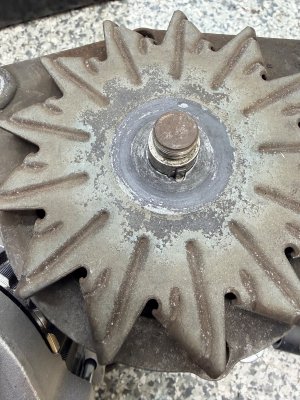
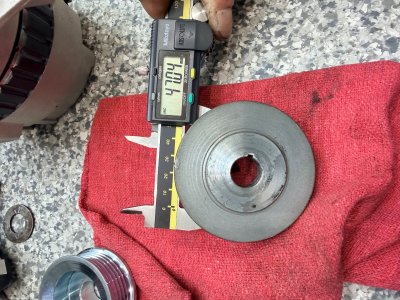
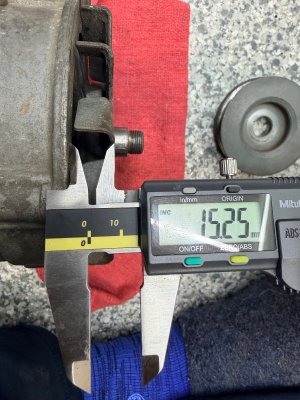
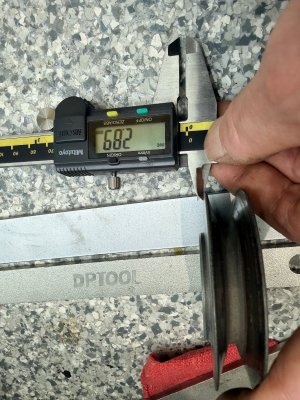
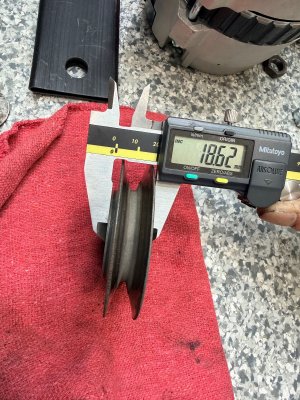

The Bosch AL655n alternator also has a fan whose front surface sits about 15.25mm off the surface of the alternator, but there’s a wrinkle here. This fan has an indentation of a few mm. The center of that indentation is 39 mm and the outer rim is 55mm.


Since the diameter of the foot on the original pulley is 44mm, when placed directly onto the new fan it is resting partially up the wall of that indentation, making its total offset 33 vs 34mm. I think if one wanted to be exact about it you’d add a few 1mm washers below that pulley just to lift it up out of the indentation and bumping out its front edge by 1mm thereby matching the original alternator.


The Bosch AL655n alternator also has a fan whose front surface sits about 15.25mm off the surface of the alternator, but there’s a wrinkle here. This fan has an indentation of a few mm. The center of that indentation is 39 mm and the outer rim is 55mm.
Since the diameter of the foot on the original pulley is 44mm, when placed directly onto the new fan it is resting partially up the wall of that indentation, making its total offset 33 vs 34mm. I think if one wanted to be exact about it you’d add a few 1mm washers below that pulley just to lift it up out of the indentation and bumping out its front edge by 1mm thereby matching the original alternator.