Anyone Using a Vacuum Tank for Brakes - 3 Webers?

andyleonard

Well-Known Member
Site Donor
Messages
197
Reaction score
43
Location
Topanga, CA
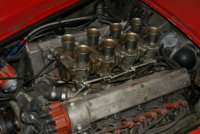
Having reduced the size of the booster from stock to a 7" dual diaphragm and mounted 3 Webers at the same time, I feel I need more vacuum for the smaller booster than I'm getting from tapping a single one of the 3 Weber manifolds. The brakes are fine on the overrun but around town more vacuum is needed.

I'm reluctant to tap all 3 manifolds (like Jaguar) and connect them all to the booster because I don't want to mix the signals, so I guess a tank is called for.

Standard hot rod big cam V8 tank?

Any wisdom?
 
I'm reluctant to tap all 3 manifolds (like Jaguar) and connect them all to the booster because I don't want to mix the signals, so I guess a tank is called for.

What's the downside of 'mixing signals'? Most V-8's have a common vacuum plenum for all 8 cylinders.
 
Jaguar E-types (series1) used a vacuum tank (accumulator) mounted low on the p-side firewall. I don’t see why this wouldn’t work for you. I would put it under the battery tray, where the evap canister goes on USA cars with emissions controls.

Have you thought about an electric vacuum pump tee-d into the line? The make these for the hot rod crowd too.
 
What's the downside of 'mixing signals'? Most V-8's have a common vacuum plenum for all 8 cylinders.
Sure. With a big multi-outlet manifold and a single carb, vacuum by definition has a mixed signal. I've never had good luck with short single barrel carb/manifolds talking to each other vacuum-wise. Z cars that have all 3 carbs with a common vacuum have been a PITA for me. Maybe it's just chemo and I made it up.
 

Attachments

  • DSC00482.jpg
    DSC00482.jpg
    322.2 KB · Views: 120
Jaguar E-types (series1) used a vacuum tank (accumulator) mounted low on the p-side firewall. I don’t see why this wouldn’t work for you. I would put it under the battery tray, where the evap canister goes on USA cars with emissions controls.

Have you thought about an electric vacuum pump tee-d into the line? The make these for the hot rod crowd too.

Sounds right. I have a Jag tank around here somewhere but I was thinking about something a little smaller. The Summit/Jegs ones seem about right. And I like the idea of maybe using a second valve. I remember using a coffee can and a soldering iron back in the day.

I seem to remember harvesting a vacuum pump off a Cadillac diesel and trying - and failing - to use it to pull vacuum in the lower end of a Pontiac roadrace motor like the drag guys do. Something about blow-by and ring seal. It's probably under the bench. I'll try the small tank first; the new booster doesn't need much more vacuum.
 
Sorry to hijack, well partly hijack it. I am interested in the logic behind the use of a vacume tank and when it is needed.

You say that the brakes are fine on overrun but more is needed around town.
I had understood that the vacume tank was needed if the engine stalled, which was clearly wrong vs what you say.
If the tank is a vacume reservoir then I assume that you need extra capacity for subsequent brake application rather than the first application, or do you end extra on the first touch if the brakes on low engine revs?

How does the science work for the length of the inlet on the carb?

I ask as I am planning the rebuild of a mk2 Jaguar with the engine from a series 3 XJ6 which I understood did not have a vacume tank. As this is a real mix and match of parts from all over the place I need to understand the science to have a chance to make it work on the first attempts. Happy to share the details but perhaps in an off topic thread.

Thanks for any help or advice.
 
Sorry to hijack, well partly hijack it. I am interested in the logic behind the use of a vacume tank and when it is needed.

You say that the brakes are fine on overrun but more is needed around town.
I had understood that the vacume tank was needed if the engine stalled, which was clearly wrong vs what you say.
If the tank is a vacume reservoir then I assume that you need extra capacity for subsequent brake application rather than the first application, or do you end extra on the first touch if the brakes on low engine revs?

How does the science work for the length of the inlet on the carb?

I ask as I am planning the rebuild of a mk2 Jaguar with the engine from a series 3 XJ6 which I understood did not have a vacuum tank. As this is a real mix and match of parts from all over the place I need to understand the science to have a chance to make it work on the first attempts. Happy to share the details but perhaps in an off topic thread.

Thanks for any help or advice.

I *think* the issue is having enough volume of vacuum to move the booster diaphragm a desired distance a desired number of times. The strength of the vacuum is affected by cam profile and other factors, so a certain engine will produce 10
 
M5bb removed his brake booster and used a hydro boost setup, he has triple webers. do a search and you can probably find what he did ... or send him a PM. i had a similar problem on my last 2002, seems like there was a small Ford brake box that solved the issue (perhaps it was an accumulator) ... that's been over 15 years ago ... but it was inexpensive and did the trick. seems to me that Korman partially solved this issue with their intake manifold by providing better vacuum.
 
Back
Top