carburetor

Sassan S

New Member
Messages
8
Reaction score
0
Location
San Jose CA
Hello All, my e9 tends to have a slight hesitancy during the initial movement from full stop as if not enough gas is getting to the carburetor, but seconds later it then gets going and accelerate normally. Could this be carburetor related (cleaning/rebuilding) ? what are other possible causes?
 
Other possible things to look at: take a look at your accelerator pedal. Make sure the rubber connection at the top of the pedal with the lever through it is intact and is not collapsing when you press the accelarator. Mine was actually partially severed when I bought my car. Get down there and push on the pedal and make sure the lever that goes through the top of the pedal moves smoothly, and that the return spring pulls the pedal back up when you release the pressure on it.

Then get under the hood and check the operation of your linkage. Make sure it operates smoothly with no binding.
 
thank you all for your replies. I am pretty sure mine are original carbs. I am very new to this but have some mechanical aptitude, so i may be asking some further questions which may be obvious on most members here. For example, How do i check the functionality of the accelerator pumps (SteveHose, HB Chris)? How will i know if they work properly? I will check on the accelerator pedal linkage (ohmess)
 
If you remove the air cleaner lid (or full assembly) you can look down the throat of the carburetors (choke open) and move the throttle to check if the pumps are squirting in each carburetor.

Do this with the engine off, open the throttle fully with a fairly quick motion and you should see a steady stream of gasoline emitting from the squirter holes, usually located in or around the venturi.

If there’s a weak stream or no stream then the pump diaphragm (usually a leather or rubber cup) will need to be replaced. This would be part of a full rebuild kit.

Once you have the air cleaner assembly removed you will be able to identify the carburetor type and order the correct kits.

Looking forward to learning what you find.
 
Not all rebuild kits have the two synthetic rubber cups, only the original were leather. Not hard to replace, just fiddly. Top cover comes off with eight or nine screws, don’t forget the one in the center under the mounting post. Then disconnect tiny choke arm and you can lift the cover.
 
The kits come with the rubber skirts for the accel pumps that tear when you look at them. There is a Mercedes part number out there for the entire pump with higher quality skirt but I can't locate it.
 
When I bought the Royze kit ten years ago there were no pump skirts and Carl had the whole pump assembly but they were crazy expensive!
 
The Walker kits had them and I promptly ruined them, they were probably poor quality like the rest of the kit.
 
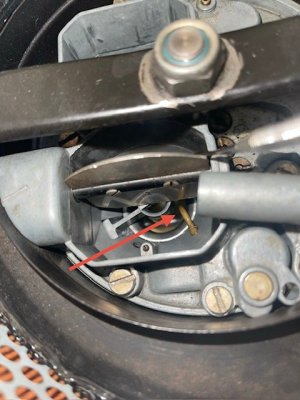
Fellow Members, i checked both Carbs. With the engine off, when pressing on the accelerator linkage, the brass nozzle (see attached pic with the red arrow), one carb had a nice stream of fuel, but on the second carb, it was dripping slowly.
With the engine running, both carbs seemed to have a spray type flow, hard to compare between the 2 carbs if one had a higher spray flow.
 

Attachments

  • fuel nozzle.jpg
    fuel nozzle.jpg
    64.5 KB · Views: 46
The key is to do it not running. When running and you crack the throttle you can see fuel flowing through the venturis, but you are looking for the shot that you get from the pump jet that overcomes the lean stumble that happens as you transition from the idle circuit.

From your description the pump jet in one carb needs replacing.
 
My carbs are stamped Solex. i think they may be either the INAT 32/40 or 35/40 model. Any guidance on how to change the accelerator pump? any diagrams would help as well as where to buy the part.
 
Go to the home page and look up the technical data, there are instructions on the Zeniths. It may look overwhelming but I had never done a carb rebuild before and it was not hard. Take tons of photos. I may not be celebrated for my statement but my Zeniths on my Bavaria work wonderfully and I wish those on my E9 were not replaced with Webers.
 
Last edited:
For what it's worth, the Zenith rebuild kit that FCP sells (sourced from Royze) comes with the leather pump cups, even though the listing photo doesn't show them. This is accurate at the time of this writing.

If a full rebuild isn't needed, Royze sells the both the leather cup as well as the complete accelerator pump individually.
That's odd. My 1970 2800CS had leather cups in the carbs and I assumed that those were there from the factory because the Blue Book I reviewed, written not too long after my car was produced, stated that the old style leather cups should be replaced with the synthetic ones which was what was in the rebuild kit I had purchased. I'd guess the leather ones work reasonably well when new, but for how long?
 
As a new steward of a coupe, I don’t have substantial experience with either to advise one way or another.

In my research here, people haven’t reported much success with the synthetic cups, so the leather cups are sought after instead.

To add to the pile of anecdotal (and somewhat speculative) evidence, my coupe has meticulous records going back to day 1, tracking every bit of work done, no matter how small. There are no indications of a carburetor rebuild being done, which suggests the guts of my carbs could be original. It has leather pump cups and they still are functional, even after sitting for the better part of 40 years.
 
Last edited:
  • Like
Reactions: Dlc
When I rebuilt the motor and carbs on the 2800 ten years ago after it sat for 34 years with only 56K miles, the original leather cups were shot and it made acceleration difficult. The replacement pumps can with synthetic cups which are still working fine.
 
Back
Top