I said I woud not do this

bavbob

Well-Known Member
Site Donor
Messages
3,670
Reaction score
1,791
Location
Boston, Ma
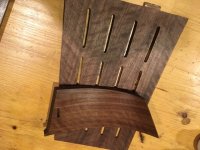
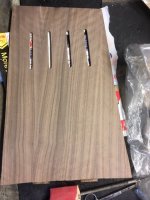
But here I go, re-laminating the wood dash and including this panel with 12 perforations. Question is, are the rubber bits available, I have never seen them discussed. Mine are all there but a little beat.


Panel.JPG
 
If you find a source, I'd love to know, but I doubt it...I could use a couple of sets. I cleaned up a set recently, and I was surprised with the result; pretty durable rubber... Missing and needing one "rib", and would give any from a rotten wood shelf a good home...(thanks, Honolulu, for the ones you saved from the garbage for me!) I wonder what our friend in eastern Europe uses..?
 
Last edited:
You're welcome Dave, sorry I didn't get the last piece. I vaguely remember it dropping into the heap as I crushed the very rotten wood to remove them. Was in a something of a rush to grab the list of bits requested by various members before the forklift came for what was left.

Frugal beast that I am, one only sees the upper portion of the rubber inserts, not the section that goes through the wood. I think one these could be molded at home in whatever material of choice, then use some stickum to set them on a flat wood surface.

The spirit of imagination is strong, the availability of elbow grease not so much.

Please describe your lamination process including if vacuum box/press, wood type and source, adhesive used u.s.w.
 
You are right about the "tip of the iceberg"; the bottom doesn't matter...let me think about what I can cannibalize....and thanks again for the ones I did get.
 
First, no affiliation, I bought this which was quarter sawed walnut. It did not splinter at all, 3M backing was very robust.https://www.ovisonline.com/Wood-Ven...z88tInGi5AUvZEf8_4kaEmmFpIIivzuAaAtJjEALw_wcB

Apologize with limited photos, I did not image as I went. I have re-finished furniture for years but never re-laminated a thing, Common sense was applied.

1) Removed all the old laminate, get level surface to place laminate on.
2) Have long 22G needles and syringes. Wood glue flows ok thru this size needle. Needle size allows you to get between all the different layers of the original wood. Re-glue all the layers that make up the wood backing.
3) Boiled linseed on the back of each piece/template since the wood was so dry. It did not undo the wood glue. If added first, the glue wouldn't work well....daaaa
4) Minwax or Varnathan wood repair to the back. This is like a thin epoxy. It strengthens the wood, especially if any rotted areas. Elmers wood repair stuff is horrible, basically watery Elmers glue.
5) Cut laminate, I cut to extend past the borders of each piece being covered. I gently made multiple light passes to cut. If you cut the thickness of the laminate in a single pass, (cut on wood side, not glue side), you can get "crush injury" to the edge of the wood.
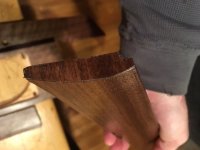
6) if you need to make an edge 90 degrees from the surface you are covering (see second image), then make a few passes to score the edge of the piece to partially cut the laminate so you can then fold.
7) Trimming, used rough cuts (leaving lots of room for error (ex for the door lever etc), then 60 sandpaper to finish. It takes the laminate down fairly quickly and makes a nice flush surface.
8) ahhh, as another member did, curves=wet the laminate and jury rig whatever to set up the curve you need. Doesn't have to be exact, the glue backing is pretty strong so will hold the final bend.
8) I did some test stains to see what I liked. I use oil-based stains, takes 24 hours to dry, but gives some protection that water-based does not.
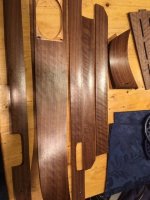
9) OOOO steel wool before top coat and between top coat layers. I used oil-based poly. Can use laquer if you choose. Keep in mind, the harder the final finish you choose , the less tolerate of temp swings before it cracks (last image shows stained only and stained and poly pieces).
10) PIA's= the speaker grill, the instrument cluster surround, the thing I posted originally. Used either fine round or flat file to get grill ends square, curves for those rubber bits. Tons of patience.

I used no vacuum bag. The cluster surround, well I was able to get around the lower 2/3. Could not get laminate to sit nicely if tried to cover the upper 1/3. Keep in mind, only the lower part shows so not big deal.

OR, send blanks to Bella and skip my DIY!


IMG_0675.JPGIMG_0677.JPGIMG_0678 (1).JPG
 
excellent description Bavbob, thanks for taking the time to explain the actual work and products used. This sort of thing motivates me to cut and shave more of the koa I have sitting about the place.

For anyone thinking to try their hand(s), the door trim pieces (in hand in the center photo above) make a good starting point. They aren't hard to remove and use as a pattern; not particularly 3-dimensional so their shape is relatively uncomplicated; most of the work is in the direction of grain so they finish nicely, and they are large enough so they aren't finicky little bitty things. Let you mind roam... combining different wood species can offer excellent contrast.

The console tray (with slots at above right, if you have the rubber strips or substitute) are pretty easy if you make a pattern first.

Experiment...
 
Yes, I did try to help, but the E23 shift panel I had only had 5 rubber slats and they were longer. So, not worth the dissection. Made me think however, that perhaps there are other '70s BMW with just the right part that could be transferable. Good luck with this Rob, you gotta do a tutorial when you solve this! Mike
 
Back
Top