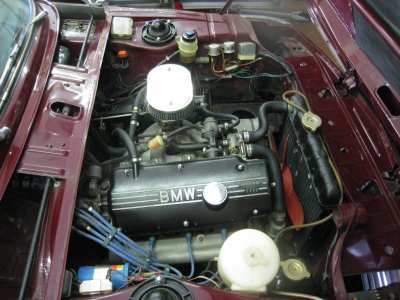
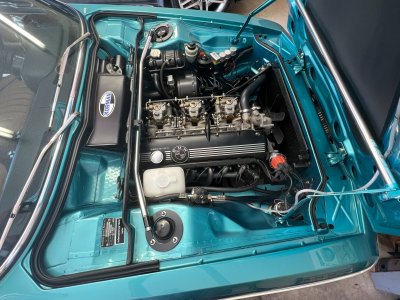
Matching number engines // does your car have it?

On older factory cars, this often matched the final digits of the vehicle's VIN, while replacement or newer blocks use standard BMW 8-digit serialization.
This seems about right. My E12 based E24 has an M90 motor with the car VIN stamped on it. The later E24s were E28 based. Unfortunately I no longer have one of those to check, But we can know that at least up to mid 1980 or maybe as late as 1982, the engines had the VIN. IU'll ask some friends onthe E24 board to check their cars.
 
My source is Chris Kohler, a recognized expert on these motors. If he says Motronic then we need to look no further. From the Wiki:

M30B34​

The M30B34 engines sold in Europe and most other markets used a 10.0:1 compression ratio and produced 160 kW (218 PS; 215 hp). In North America and Japan, the M30B34 used an 8.0:1 compression ratio and produced 136 kW (185 PS; 182 hp). This engine was also offered in Europe from the latter half of 1985 until mid-1987. In all markets, the Bosch Motronic digital fuel injection system was used. The bore is 92 mm (3.62 in) and the stroke is 86 mm (3.39 in). The 1979 732i is BMW's first use of Bosch's Motronic fuel injection in the m30b32.

Applications:

  • 1982-1987 E23 735i / L7
  • 1982-1987 E24 635CSi / L6 — 218 PS (160 kW) in Euro spec
  • 1985-1988 E28 535i / 535is / M535i
 
I own both extemes--My 1973 3.0CS has a block from a 733 with the VIN stamped on it. The head has "86" stamped on it. That's how Korman Autoworks built it in 2005. My 1972 2002 has the matching VIN on the block and the chassis. That's because I'm the original owner and rebuilt the engine myself and had a machine shop do the valve job on the original head.
We are fortunate to own E9's that don't lose any value with replacement engines and drivetrains.
 

Attachments

  • IMG_2184.JPG
    IMG_2184.JPG
    339.3 KB · Views: 26
  • IMG_3936.JPG
    IMG_3936.JPG
    383.1 KB · Views: 25
Despite the fact my E9 have "matching numbers" not for every car it bring any value.

Most of motorsport cars have had many engines (and even bodies) so this is not the case for consideration.

BMW E9/E3/E10... is kind a car which is expected to enjoy the User driving it.

For many historic cars or low mileage ones it might bring some value as a mark of originality. On the other car someone who would like to drive might be happier having newer, fresh engine than original but weak and worn.

For some countries engine number was required to be in the registration ID. It was done from few reasons but it is problematic at some point for the user. Many shops were good at stamping numbers on the body or engine (fraud, stolen parts etc.). I'm pretty sure some countries are still recording engine numbers next to chassis one.
 
My coupe has 78k miles and the original, numbers-matching motor. For E9s I’m not convinced that brings any added value. But in the spirit of preservation, it does inspire me to rebuild this tired boat anchor (with Mahle 9.5:1 pistons, Schrick cam, big Webers) rather than doing the engine swap thing.
 
My car has the original matching engine, although it has been upgraded somewhere along the line (I have piano top pistons).

That said, the paint is not a BMW color, the seats are not BMW seats and the interior is not a BMW color. Not sure the whole numbers matching thing is adding much value for me.
 
I have a numbers matching engine, but the head is not. When I had a new upgraded head installed, I gave the shop my original head to transfer all the useable parts. I asked for the original head to be returned but they threw it in a pile of old heads. I was told they found my head, but when I picked it up it was not mine. I just took what they gave me because it was an upgraded version and I could use it as a spare.
 
Back
Top