The original clear varnish on the dashwood is what? I have hit it with every chemical I know and it just doesn't soften up.

You are using an out of date browser. It may not display this or other websites correctly.
You should upgrade or use an alternative browser.
You should upgrade or use an alternative browser.
Original Wood Finish
- Thread starter bavbob
- Start date
I am not sure you would want to use it on wood, but the 'Aircraft finish remover' would probably remove it

My guess given the era would be satin laquer, was yours refinished with polyurathane or something more resistant?
Mine is OEM. I have used BIX stripper for years on all types of furniture without an issue, this laughs at it. Perhaps something x-linked or something like that from 50 years in UV light. Just thought someone had been here before.

I know some German wood is finished with an epoxy clear (especially steering wheels). Not sure about this era and the dash wood, however! I did some refinishing of wood trim in my Porsche 928 GTS. It took about 8-10 'doses' of citrus stripper as I recall, with some mild sanding between each stripper treatment. TOUGH stuff.
I wish they could have produced and used rubber and plastic parts that were as indestructible as the wood finishes.
Gary
I wish they could have produced and used rubber and plastic parts that were as indestructible as the wood finishes.
Gary
I fiddle with our wood parts some, and other furniture projects...I agree that its bullet-proof, and my guess is an early catylized lacquer. The Europeans in the furniture industry were the first to start trying more alcohol and water resistant finishes in the late 60's and 70's (cat lacquer, and later, polyester flat line finishing, and polyuethane). I, too, have tried everything to strip, and finally resorted to abrasives. And even that takes alot of time, and sorta stinks. On some dashes that have top coat that has cracked and lifted, you can slide a thin pc of metal (an erasing shield, i.e.) or an xacto blade under and chip and pry (wear some glasses; small, sharp, shards flying at your face..), but often the "skin" pulls the first layer of veneer, or you get gouges in it. So, the patient use of abrasives is what I am using....usually assuming that the top layer will have to be replaced from slight sand-thoughs, etc, anyway.
On the other hand, I'm pretty sure they still used hide glue at that time, which is...de-lamination drum roll please...water soluble. Which is why our wood de-lams at the ends/corners...or in desert cars, the hide glue cooks and turns back into crystaline dust...its a harsh environment for wood in a cold, hot, wet, arid greenhouse...Sorry so wordy..
I agree with Gary, they should have dipped the whole car in the wood finish vat...
On the other hand, I'm pretty sure they still used hide glue at that time, which is...de-lamination drum roll please...water soluble. Which is why our wood de-lams at the ends/corners...or in desert cars, the hide glue cooks and turns back into crystaline dust...its a harsh environment for wood in a cold, hot, wet, arid greenhouse...Sorry so wordy..
I agree with Gary, they should have dipped the whole car in the wood finish vat...
I let the Bix stripper sit for an hour instead of the usual 30 min. It liquified a few mm so this is the approach. I am doing the center console piece. All others will get new veneer, this will be stained to match. Re veneer of this part would be massively time consuming.

Re veneer of this part would be massively time consuming.
Im just curious. Why would this piece so time consuming?
All those perforations that must be cut in the new veneer to fit the rubber bits.
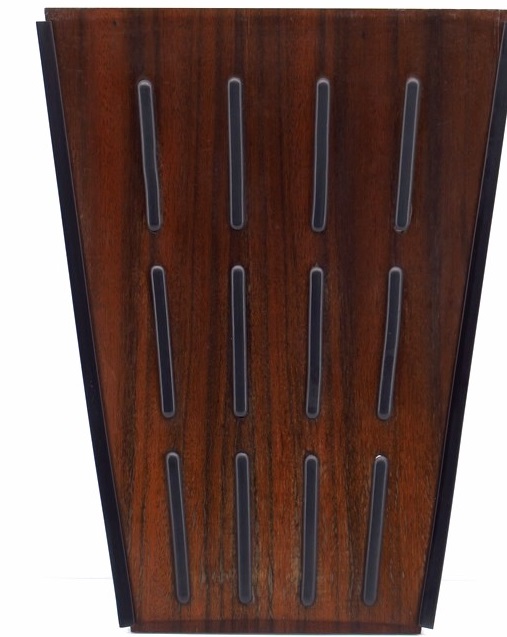

I understand that the original finish was the same lacquer as used on the bodywork, cheap and fast drying.
I found that the lacquer on the door tops was hard to remove and I used wet n dry sandpaper.
For the dash grab rail, this may not be fitted to US cars, I used the back of a razor blade pulled gently across the surface. The old lacquer just flaked off, I guess it was degraded by sunlight, hot cold etc.
Where the veneer had lifted in places I used hot pva glue injected into the gap and various clamps to hold it.
Then I finished with several station coats of lacquer.The result was vastly superior than the starting point, So I am happy.
I found that the lacquer on the door tops was hard to remove and I used wet n dry sandpaper.
For the dash grab rail, this may not be fitted to US cars, I used the back of a razor blade pulled gently across the surface. The old lacquer just flaked off, I guess it was degraded by sunlight, hot cold etc.
Where the veneer had lifted in places I used hot pva glue injected into the gap and various clamps to hold it.
Then I finished with several station coats of lacquer.The result was vastly superior than the starting point, So I am happy.

I really struggled to get it off my trim when I restored it. Found the best option for pieces (where the underlying veneer was in good condition) was to use very fine wet and dry on it and then simply re-finish with single pack lacquer. Came up a real treat. For bits in worse condition I did the same but back to timber then re-glued, patched etc. This also allows for colour matching, which can be a real pain if replacing parts.
Chemical stripper I used was heavy duty but took multiple applications. Followed by sanding, then oooo steel wool.
Few benefits of being a physician these days ...but 20 and 22G needles and syringes filled with wood glue. I can reach any laminate coming undone. The curves on the dash are multiple layers on top of each other, sequentially getting shorter and shorter. All these seem to come unglued but with careful application and patience, you can make them solid again. I have been finishing up with linseed oil application to the surfaces not being laminated. Any soft wood then gets an application of wood hardener.
As an side, I contacted Maderaconcepts to price the wood dash base that is covered with black vinyl.The price was almost $300 so I guess I will get the plunge router out.
Few benefits of being a physician these days ...but 20 and 22G needles and syringes filled with wood glue. I can reach any laminate coming undone. The curves on the dash are multiple layers on top of each other, sequentially getting shorter and shorter. All these seem to come unglued but with careful application and patience, you can make them solid again. I have been finishing up with linseed oil application to the surfaces not being laminated. Any soft wood then gets an application of wood hardener.
As an side, I contacted Maderaconcepts to price the wood dash base that is covered with black vinyl.The price was almost $300 so I guess I will get the plunge router out.
Bob
I also injection the pva with a syringe, my equipment was left over from an out of date medical kit from my overseas adventures.
I also injection the pva with a syringe, my equipment was left over from an out of date medical kit from my overseas adventures.