WTB 72 CSI Ignition Switch

E9inus Maximus

Active Member
Site Donor $
Messages
62
Reaction score
25
Location
Miami, Florida
Greetings from Miami, I've been looking for an ignition switch. I recently had the body fully restored and repainted on my 72 CSI after an unfortunate accident. It is solid and looks fantastic again but I can't get it to start. I tried all the usual routes and it won't even crank. I turn the key, lights and gauges come on and nothing else, not a sound. Checked all my grounds and 2 underhood relays, relay ground at ecu under rear seat, MAP plugged in correctly, CSV ok, starter works fine, engine ground to firewall ok, grounds in trunk ok, pertronix ignition, checked ecu grounds and swapped ecu's...etc. I've turned my attention to the ignition switch. The accident had broken the steering wheel, a wooden Momo. The impact was frontal, it cracked and splintered the wood wheel and bent the three metal spokes backwards as there was quite an impact through the steering column. When I turn the key, there is power but nothing else. After turning the key, it springs back to normal but the process seems vague or possibly lighter than normal since there is nothing that happens. I can't hear the fuel pump or the clicking to fuel injectors. No power at injectors either. Wondering if the switch is toast or if anyone has either of the early metal ignition switches 61321355148, 61321351851 or an E21 metal ignition switch 61321366061 which I understand can easily be made to fit. I've read about the adaptable plastic ignition switches that @sfdon and Carl Nelson have mentioned as well. The 61321355148 shows as available from Maxmillian Imports but there are issues with their website lately. Any and all help is appreciated.
 
I went through this replacement earlier this year. Our Coupes are 50+ years old now, and key has been turned so many many times that these switches have worn out and have been replaced, or, are about to fail and will need to be replaced. I discovered the exact part number replacements have disappeared, and we are left with, last time I checked, 61321366107. Must be adapted, but can be done, and your ignition will function as new again. Recommend getting one before these are NLA as well. Just call Carl and get one from him. Good luck! Mike
 
When we do this job at the shop, we look at the ignition switch, particularly where the insert goes into the switch. We look at the lock cylinder, particularly where the corresponding metal pieces go into the lock and to the ignition switch and then we look at the lock, replacing one when the others are worn out does you no good.
Examine all three pieces as a unit
 
Last edited:
Greetings from Miami, I've been looking for an ignition switch. I recently had the body fully restored and repainted on my 72 CSI after an unfortunate accident. It is solid and looks fantastic again but I can't get it to start. I tried all the usual routes and it won't even crank. I turn the key, lights and gauges come on and nothing else, not a sound. Checked all my grounds and 2 underhood relays, relay ground at ecu under rear seat, MAP plugged in correctly, CSV ok, starter works fine, engine ground to firewall ok, grounds in trunk ok, pertronix ignition, checked ecu grounds and swapped ecu's...etc. I've turned my attention to the ignition switch. The accident had broken the steering wheel, a wooden Momo. The impact was frontal, it cracked and splintered the wood wheel and bent the three metal spokes backwards as there was quite an impact through the steering column. When I turn the key, there is power but nothing else. After turning the key, it springs back to normal but the process seems vague or possibly lighter than normal since there is nothing that happens. I can't hear the fuel pump or the clicking to fuel injectors. No power at injectors either. Wondering if the switch is toast or if anyone has either of the early metal ignition switches 61321355148, 61321351851 or an E21 metal ignition switch 61321366061 which I understand can easily be made to fit. I've read about the adaptable plastic ignition switches that @sfdon and Carl Nelson have mentioned as well. The 61321355148 shows as available from Maxmillian Imports but there are issues with their website lately. Any and all help is appreciated.
Experience with E3s and E9s, would lead many to initially suspect a bad electric ignition switch assembly. It was once somewhat simple to install a known good switch to quickly determine whether the switch is actually the problem. However, considering your use of the word “restored” along with your symptoms recital, one wonders if you don’t have some non-ignition switch wiring “issues” rather than a bum ignition switch.

Before searching the globe and Dade County for a replacement switch, consider that there are a number of ways to hot wire your car, in order to start the engine. This can be as simple as installing a remote hard wired starter using the diagnostic service plug that was originally found on the fender well near the brake fluid reservoir. Another thought is to test your switch with a multimeter. This could be accomplished in the car (battery disconnected). Alternatively, remove the switch and carefully disassemble the case (some minor prying may be required) and the simple electrical contact configuration and related functions should be self-explanatory.

BTW, even if all of the above suggestions seem daunting, remove the grub screw and physically remove the switch from its steering assembly cradle. What do you see? Is the “staked” metal case loose? Can you wiggle it or does it look/feel as though it can be crimped together - “tighter?” If you notice any of these conditions, look at the images found in threads covering the topic.;)

https://e9coupe.com/forum/threads/diagnostics-port-info.48316/#post-424687
https://e9coupe.com/forum/threads/ignition-switch-mating.47682/#post-418724
https://e9coupe.com/forum/threads/intermittent-ignition-switch.45708/#post-403056

iu


img_7737-jpeg.204960


iu
iu
iu
 
Last edited:
Experience with E3s and E9s, would lead many to initially suspect a bad electric ignition switch assembly. It was once somewhat simple to install a known good switch to quickly determine whether the switch is actually the problem. However, considering your use of the word “restored” along with your symptoms recital, one wonders if you don’t have some non-ignition switch wiring “issues” rather than a bum ignition switch.

Before searching the globe and Dade County for a replacement switch, consider that there are a number of ways to hot wire your car, in order to start the engine. This can be as simple as installing a remote hard wired starter using the diagnostic service plug that was originally found on the fender well near the brake fluid reservoir. Another thought is to test your switch with a multimeter. This could be accomplished in the car (battery disconnected). Alternatively, remove the switch and carefully disassemble the case (some minor prying may be required) and the simple electrical contact configuration and related functions should be self-explanatory.

BTW, even if all of the above suggestions seem daunting, remove the grub screw and physically remove the switch from its steering assembly cradle. What do you see? Is the “staked” metal case loose? Can you wiggle it or does it look/feel as though it can be crimped together - “tighter?” If you notice any of these conditions, look at the images found in threads covering the topic.;)

https://e9coupe.com/forum/threads/diagnostics-port-info.48316/#post-424687
https://e9coupe.com/forum/threads/ignition-switch-mating.47682/#post-418724
https://e9coupe.com/forum/threads/intermittent-ignition-switch.45708/#post-403056

iu


img_7737-jpeg.204960


iu
iu
iu
Thank you for your advice. I agree, I did hotwire the car, I jumped it to get it to run briefly with starter fluid but I have no signal to the injectors. It won’t stay running. I don’t have any hacked up wiring on the car either. Took very good photos and notes prior to disassembly to wire everything back exactly as it was. Fairly straightforward. Wiring on my car is old but still looks good. Car ran fine with it prior to restoration. I understand there’s always something I may have missed but I spent quite some time diagnosing prior to turning my attention to the switch. I found a metal E21 switch which is nearly identical to E9. Someone posted an install here for this particular switch, different wires as others but exactly the same size and seemingly easier to adapt (clip and file the protruding pin and install) fits perfect. I don’t love the idea of removing material from the plastic 107 switch to fit the barrel. I’ll be trying this metal switch to see if it resolves my issue. I’ll try to examine and if necessary repair my old switch if possible. I intend to check the barrel and lock assembly as well. To make sure all is in order there too.
Thank you, Dan
 
Hi Dan,
since you assume the ignition switch to be the culprit I would suggest to start your trouble-shooting at this point.
This shows the electrical symbol
ignition_switch.jpg
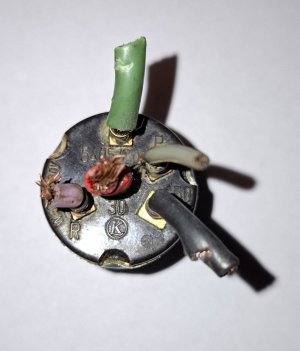
and this the backside of the switch with cables been cut off
ignition_switch connections.jpg
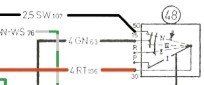
And this the wiring diagram
As you can see the red core connected to terminal "30" in the centre comes directly from "+" of the battery. Depending on the position of the key the other terminals receive power.
- terminal "P", grey core, receives power if the battery is connected, even if any key is inserted. The parking lights switch is connected to this terminal
- terminal "R", violet core, receives power on the first key position and supplies the radio. Is stays energized also at the next two key positions
- terminal "54 (15/61)", green core, receives power on the second (and third) key position. It supplies the lighting, the ignition and others. On the CSI it furthermore energises the main relais followed by the initial starting of the fuel pump.
- terminal "50", black core, receives power on the third (and second) key position. It energises the starter coil.

If you tell that on the second key position, lights etc. get energised but not the fuel pump then I conclude that there is a problem in the connection of the green core connecting the ignition harness. And the black core.
Disconnect your battery. Use a meter to verify the key position and the described switching between red core and green/black core.

Thomas
 
Last edited:
I did hotwire the car, I jumped it to get it to run briefly with starter fluid but I have no signal to the injectors. It won’t stay running. I don’t have any hacked up wiring on the car either. Took very good photos and notes prior to disassembly to wire everything back exactly as it was. Fairly straightforward. Wiring on my car is old but still looks good. Car ran fine with it prior to restoration. I understand there’s always something I may have missed but I spent quite some time diagnosing prior to turning my attention to the switch. I found a metal E21 switch which is nearly identical to E9. Someone posted an install here for this particular switch, different wires as others but exactly the same size and seemingly easier to adapt (clip and file the protruding pin and install) fits perfect. I don’t love the idea of removing material from the plastic 107 switch to fit the barrel. I’ll be trying this metal switch to see if it resolves my issue. I’ll try to examine and if necessary repair my old switch if possible. I intend to check the barrel and lock assembly as well. To make sure all is in order there too.
Thank you, Dan
Your narrative is unclear. Your original post indicates a no-crank condition with the current ignition switch, yet in a follow-up you indicate being able to crank the engine with a remote starter. If you are unable to start the engine, even with a remote starter, unless the remote is incorrectly connected, it seems illogical that a replacement ignition switch will enable you to start the engine. At least, if your current ignition switch or the remote starter workaround allows you to crank the engine over and ignite starter fluid, perhaps your ignition system is functional and the issue can be sourced to the injection system. (“Perhaps.” You mention pertronix. Even though it seems an unlikely culprit, it might not be a bad idea to double check your ignition coil, its wiring (including any ballast resistor (if still used) and the distributor cap and rotor.)

If your car experienced a front end collision, it would not necessarily be a surprise for the impact to have affected a number of “older” mechanical fuel injection parts. This includes the points that trigger the injectors found at the bottom of the distributor - and the relays that you mentioned in your first post. As you know, as a built-in safety feature, one of those relays is designed to disconnect the electric fuel pump in the event of a serious collision. There are ways to test all of these components, with which you are evidently familiar. Nevertheless, often the fault may be not be obvious to the eye, absent a physical examination of the actual circuit boards, with the covers removed. Of course, if you have swapped out each relay for a known good version, you do not have to read farther. However, your location and its humidity can easily result in unforeseen corrosion. And then there are worn/bent contact points. This also includes seemingly pristine connectors for all electric fuel injection components and/or brittle, potentially compromised wiring. Lastly, you mention checking the manifold pressure sending unit. Even if that device functions perfectly and it is attached to gold-medal winning wiring, it is only as good as the vacuum hose connected to it. If the hose is loose or compromised . . . you get the picture.


iu
 
Hi Dan,
since you assume the ignition switch to be the culprit I would suggest to start your trouble-shooting at this point.
This shows the electrical symbol
View attachment 213199
and this the backside of the switch with cables been cut off
View attachment 213203
And this the wiring diagram
As you can see the red core connected to terminal "30" in the centre comes directly from "+" of the battery. Depending on the position of the key the other terminals receive power.
- terminal "P", grey core, receives power if the battery is connected, even if no key is inserted. The parking lights switch is connected to this terminal
- terminal "R", violet core, receives power on the first key position and supplies the radio. Is stays energized also at the next two key position
- terminal "54 (15/61)", green core, receives power on the second (and third) key position. It supplies the lighting, the ignition and others. On the CSI it furthermore energises the main relais followed by the initial starting of the fuel pump.
- terminal "50", black core, receives power on the third (and second) key position. It energises the starter coil.

If you tell that on the second key position, lights etc. get energised but not the fuel pump then I conclude that there is a problem in the connection of the green core connecting the ignition harness. And the black core.
Disconnect your battery. Use a meter to verify the key position and the described switching between red core and green/black core.

Thomas
Hi Tom,
I’ve poured over your posts quite a few times in the past and grateful you sent this. I do have the diagrams but your explanation will save me a great deal of time. I was wondering about the wires back there to finish the job. The green wire being suspect makes sense if it energizes the relays and initializes the FP. I would think my car still has its original switch in it.
Your narrative is unclear. Your original post indicates a no-crank condition with the current ignition switch, yet in a follow-up you indicate being able to crank the engine with a remote starter. If you are unable to start the engine, even with a remote starter, unless the remote is incorrectly connected, it seems illogical that a replacement ignition switch will enable you to start the engine. At least, if your current ignition switch or the remote starter workaround allows you to crank the engine over and ignite starter fluid, perhaps your ignition system is functional and the issue can be sourced to the injection system. (“Perhaps.” You mention pertronix. Even though it seems an unlikely culprit, it might not be a bad idea to double check your ignition coil, its wiring (including any ballast resistor (if still used) and the distributor cap and rotor.)

If your car experienced a front end collision, it would not necessarily be a surprise for the impact to have affected a number of “older” mechanical fuel injection parts. This includes the points that trigger the injectors found at the bottom of the distributor - and the relays that you mentioned in your first post. As you know, as a built-in safety feature, one of those relays is designed to disconnect the electric fuel pump in the event of a serious collision. There are ways to test all of these components, with which you are evidently familiar. Nevertheless, often the fault may be not be obvious to the eye, absent a physical examination of the actual circuit boards, with the covers removed. Of course, if you have swapped out each relay for a known good version, you do not have to read farther. However, your location and its humidity can easily result in unforeseen corrosion. And then there are worn/bent contact points. This also includes seemingly pristine connectors for all electric fuel injection components and/or brittle, potentially compromised wiring. Lastly, you mention checking the manifold pressure sending unit. Even if that device functions perfectly and it is attached to gold-medal winning wiring, it is only as good as the vacuum hose connected to it. If the hose is loose or compromised . . . you get the picture.


iu
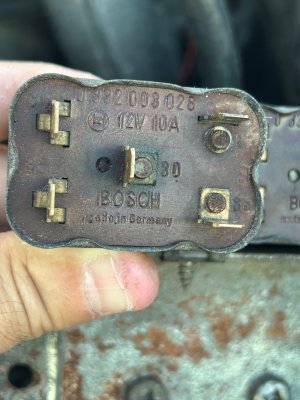
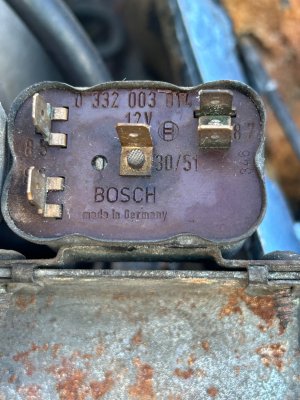
I apologize if anyone misunderstood but I didn’t mention a remote starter, I merely jumped the starter. I replaced the distributor after the accident with a correct original Bosch unit I got from Eric at CK, a new correct CSI distributor cap, new Pertronix pick up magnet and I have a new coil and others to swap just in case. No ballast resistor on my setup either. The points that trigger the injectors at the bottom of the distributor is something worth investigating. That area was somewhat affected, the top of the distributor housing cracked slightly but nothing visually too severe. I get the picture though, I’ll thoroughly keep examining it. I do not have spares for either of the main relays behind/below the brake booster. I believe the part numbers are 0332003014 and 0332003028. I found the 014 online but nothing anywhere for the 028. Does anyone have an extra 028? Photos of relays included.
 

Attachments

  • IMG_5018.jpeg
    IMG_5018.jpeg
    542.5 KB · Views: 5
  • IMG_5020.jpeg
    IMG_5020.jpeg
    666.3 KB · Views: 6
Last edited:
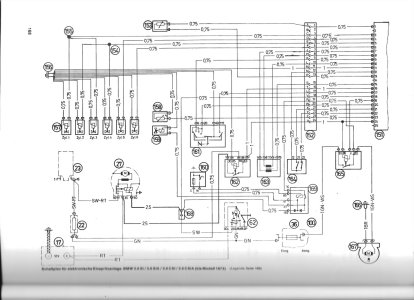
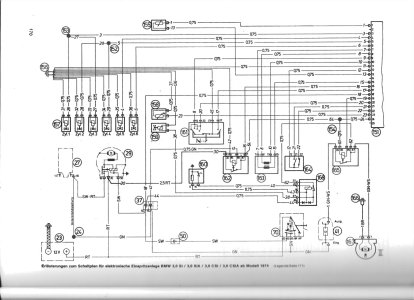
Hi Dan, not sure if you have these injection diagrams, one until ´72, the other one from ´73 onwards. The difference is due to the modification on the coil´s ballast resistor. Anyhow very important to see how the black core going to the starter coil is wired in different ways.
injection until 72.jpginjection from 73.jpg
The cold start relais looks a little bit tricky, but it´s easy to check. Same as the main relais. I will let you know, pretty sure they both are still ok if the were ok before the crash.

Regards

Thomas
 
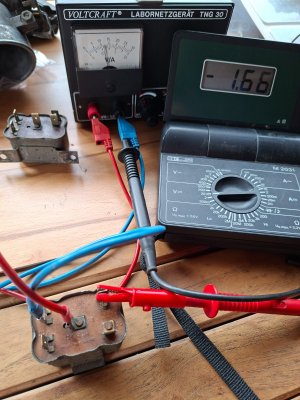
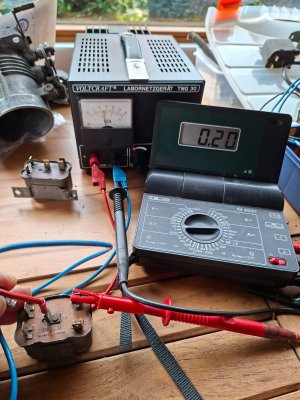
Testing of the cold start relay which works as a self-hold relay

You need a 12V DC power source and a voltmeter.
- connect the minus at terminal 85
- connect the plus at terminal 30
20251022_120708.jpg
- connect the minus of your voltmeter with the minus of your power source
- connect the plus of your voltmeter with terminal 87
- you should see the voltage at a value near 0V
20251022_120805.jpg
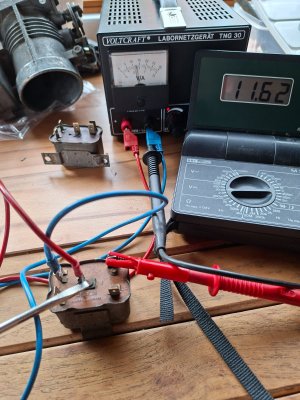
- jumper terminal 86c and terminal 30 short-time
- the relay should energize and keep energized showing the voltage of your power source at terminal 87
20251022_120819.jpg
- if you disconnect the minus at terminal 85 the relay should get de-energized again

Note: electricity is dangerous to life - only qualified people should execute this testing.
Must be said even we are working with 12V DC only.

Thomas
 
As a serial restorer for 40 years, I just have to say that this really is an amazing forum. I get a bit disillusioned by the original and keep it like it was born versus making improvements dialogue, but the depth of experience and legitimate efforts to help those in need is remarkable. Very well done.
 
Back
Top