

You are using an out of date browser. It may not display this or other websites correctly.
You should upgrade or use an alternative browser.
You should upgrade or use an alternative browser.
1973 Ignition question
- Thread starter pickman
- Start date
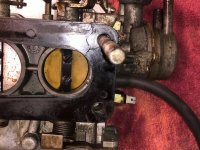
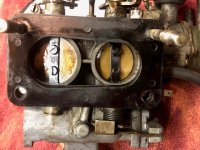

Weber 32/36 based on the throats
HB what does this tread mean?
Just that you have Weber carbs and yes that spacer should be replaced, it could be leaking air.
Will keep you updated as I tear these down BTW is a real issue removing the rear carb form the manifold.

Get new ones?
The front carb is partially disassembled it shows a lot of residue -dirt see attached. The larger barrel jet looks like 175 and the smaller is 170 as this is for a 3.5 L do these look correct?
Attachments
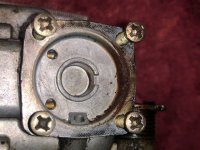
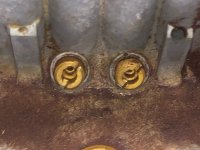
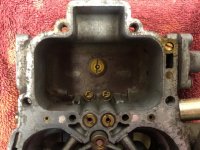
I looked into that it seems like they run $800 a set?Get new ones?
Carbs rebuilt installed and still spitting and flames up top. Removed carbs again and found the electric idle jets not working properly and the liquid chokes marginal. Reworked installed with all new gaskets "again" new plugs. Runs very smooth idles at 850-900 RPM got sore fingers. Now the question for the forum and advice, my original distributor has issues and does not work well installed the old Mallory unilite - there is no advance setting on this no vacuum ports. I am looking for advice on the last piece distributor. I did use a timing lite to set the timing. Please advise.

jmackro
Well-Known Member
I looked into that it seems like they run $800 a set?
That sounds awfully high. I see 32/36 DGEV's at Pierce Manifold for $220 apiece. See: https://www.piercemanifolds.com/category_s/453.htm
Yes correct that was for a complete kit plus some extras a verbal NTE figure. Thanks for the link.

When you speak of rebuilding, did you remove all the calibrated parts and soak the carb bodies in some type of carb cleaner (then dry and blow out the air passages with compressed air) so as to remove all the grime shown in your prior pictures. If not, this needs to be done. And your calibrated parts need to be clean too. Given the amount of grime showing in the bottom of the bowl, it is possible that some of the passageways inside the carb are clogged up. This would inhibit the carb's ability to use differential air pressure to create a fuel mixture, and could well explain your backfiring problem as fuel is flowing but air is not. If you cannot get the carbs really clean, they need to be replaced.
Once we get past cleanliness, I need ask about a comment you made. When you say "electric idle jets not working properly and the liquid chokes marginal," I find this confusing.
I am not familiar with electric idle jets. My understanding is that idle jets operate off of engine vacuum. Can you post a picture of the electric part you tested that is not working properly, and describe what happens when this part doesn't work properly?
Also, when you say that the liquid chokes are marginal, what exactly are they doing? If they do not operate so as to close off the throats at all, you may be able to put this aside for now and live with the fact that your car will not run well until it warms up. On the other hand, if they marginally operate so as to effect the movement of the throttle plates when the engine is warm, you cannot tune around this and they must be addressed before you forge ahead.
Once we get past cleanliness, I need ask about a comment you made. When you say "electric idle jets not working properly and the liquid chokes marginal," I find this confusing.
I am not familiar with electric idle jets. My understanding is that idle jets operate off of engine vacuum. Can you post a picture of the electric part you tested that is not working properly, and describe what happens when this part doesn't work properly?
Also, when you say that the liquid chokes are marginal, what exactly are they doing? If they do not operate so as to close off the throats at all, you may be able to put this aside for now and live with the fact that your car will not run well until it warms up. On the other hand, if they marginally operate so as to effect the movement of the throttle plates when the engine is warm, you cannot tune around this and they must be addressed before you forge ahead.
Electric idle jets in this case I would think are the ones that shut off fuel when ignition is off?
The carbs were completely dis-assembled the calibrated parts soaked in carb. cleaner and tooth brushed and blown off. The die cast bodies were cleaned with carb. cleaner and then soaked in pine-sol for a couple days and scrubbed with tooth and other brushes. Blow out with air. The liquid chokes were very corroded and required a lot of rework to get the calibrated parts functioning. I'll take a photo of the electric jets and post. There were definite vacuum leaks at the bases the base of the carbs had been leaking for some time and had a large build up of carbon and corrosion - which required 1000 grit sand paper on a flat plate to get them smooth again. With new phenolic plates and gaskets - and new plugs all my issues are resolved. The forum advice was correct the vacuum leaks were 90% of the issue. I have a very nice idle at about 700 RPM all advice appreciated - I now have some carb experience.

Do you have to jumpwire the resistor? How did you do the wiring? I’ve got the same setup: 123 and red coil.If you get a 123 then you'll need a Bosch red coil and no ballast resistor - nothing else. Jay is right, otherwise it depends on which coil, points/condenser or electronic (Pertronix) etc you decide to use.
Same question I just asked Steve: I’ve got the same setup: 123 and red coil. Do you have to jumpwire the resistor? How did you do the wiring?You should ditch the resistor. If the coil is above 1.5 ohm you should be fine without it. Just swapped my e-type distributor out with the 123 and it's great. Cleared up a bunch of issues...
Electronics and me are not the best friends...

Don’t forget to disconnect the black/red wire at 12:00 position of starter, it is no longer needed during starting.
As a FYI- 1974 models do not have a ballast resister.
The green wire coming from ignition switch turns into a resister wire instead.
Looks a lot like speaker wire.
The green wire coming from ignition switch turns into a resister wire instead.
Looks a lot like speaker wire.
Easist way is to disconnect one lead at the resistor and plug it in at the other side. You can install a multi spade attachment if you don't have enough spades. Otherwise with a meter find out which wire is +12v with the ignition at the start and run position and plug it directly to the + side of the coil. The 123 goes to + and - side of the coil (red & black respectively) and blue goes to ground.
Same question I just asked Steve: I’ve got the same setup: 123 and red coil. Do you have to jumpwire the resistor? How did you do the wiring?
Electronics and me are not the best friends...