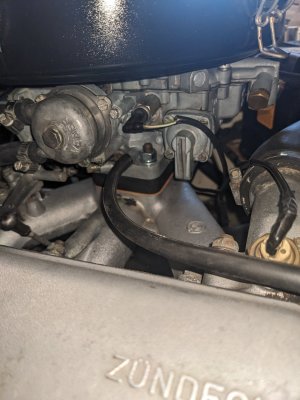
A confusing carb setup on a '71 Bav/2800

rblongboarder

Well-Known Member
Messages
1,099
Reaction score
484
Location
Southern California
My '71 Bav/2800.. it's idling very high.. nearly 1600-1800 rpm.. but the carb config is not stock. I've removed the twin air filters to get access to everything near the carbs..

According to my blue books (Section 13), a '71 Bav/2800 (M30B32V engine) came with twin Zenith INAT 35/40's. However, the previous owner swapped the Zeniths for Webers.
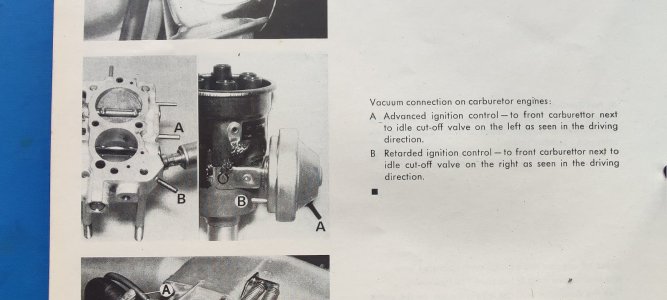
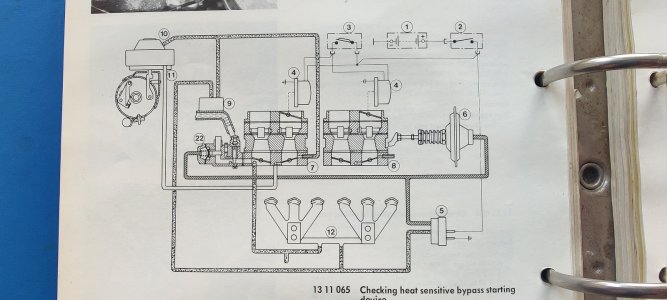
  • The first image is the vacuum feedback system for Zenith carbs (blue book pg 13-11/6). It shows dual vacuum connections between the distributor and Zeniths.
  • The second image has additional details of the advance / retard vacuum hookups between the Zenith and distributor (blue book pg 12-11/2). As best I can tell, Webers only have 1 vacuum port, whereas the Zeniths have two.. one before and after the Zenith carb vane.

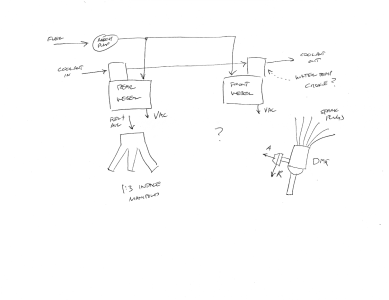
What are the proper vacuum connections between this distributor and the Webers? (I drew out a quick diagram.. the webers have a coolant feed which I believe is a cold-start choke.)
 

Attachments

  • 2800Bav_ZenithCarbDiagram.jpg
    2800Bav_ZenithCarbDiagram.jpg
    215 KB · Views: 26
  • 2800Bav_DistributorVacuum.jpg
    2800Bav_DistributorVacuum.jpg
    222.2 KB · Views: 21
  • Weber-Distributor-Diagram.png
    Weber-Distributor-Diagram.png
    190.8 KB · Views: 24
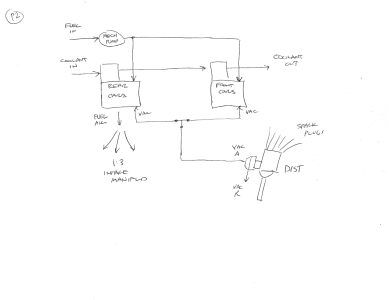
Vacuum advance comes from cone shaped side of dizzy diaphragm and goes to Weber port above the main throttle plate. Don’t worry about retard yet but it goes below throttle plate from the manifold. Plug any unused carb ports or split the vacuum lines to each carb.
 
Diagram 2 based on your comments.
  • As an alternate, I could remove the vacuum tee, and simply plug the vacuum port on the rear carb.


I haven't found a vacuum port on the manifold yet... will pick that up tomorrow...
 

Attachments

  • Weber-Distributor-Diagram2.png
    Weber-Distributor-Diagram2.png
    194.3 KB · Views: 22
A fairly similar vacuum discussion from awhile back:


Another very relevant discussion:
 
Last edited:
Usually on those, the base plate that the carb sits on will have a manifold vac port on it. I can’t remember if yours did.
Chris, does he even need the retard hooked up or just plugged?
 
I agree with the above suggestions, but do the vacuum connections have anything to do with rblongboarder's high idle speed? Those coolant operated chokes can be finicky; might one or both be stuck on the "cold" setting, kicking up the throttle stop position? That's why I run manual chokes on my downdraft Webers; the cable never sticks.
 
@jmackro that's what I was thinking too Typically the car will idle around 1800 rpm in the cold start, kick up setting.

@rblongboarder try letting the car fully warm up. Does the idle come down? Once warm the fast idle cam should automatically release to bring idle to approx 950 or so. Or can you stomp the throttle to release the high idle cam on the carbs? Otherwise check your high idle adjustment settings.

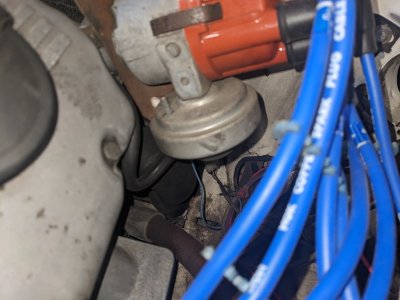
Regarding your vacuum question here is a pic of my vacuum advance as @HB Chris described. No retard hooked up.
 

Attachments

  • PXL_20261021_153252800.jpg
    PXL_20261021_153252800.jpg
    191.8 KB · Views: 17
  • PXL_20261021_153303429.jpg
    PXL_20261021_153303429.jpg
    254.7 KB · Views: 15
Thanks for the photos and advice everyone.. to the collective, I think I might have a combination of three possibilities:


Part 1:

Referring to the links above: Steve Hose makes an interesting comment: "I suggest keeping the two teed ported vacuum lines to the advance. This smoothes out the signal."

I interpret that as.. merging the carb vacuum ports with a T is essentially a pneumatic average of vacuum above both throttle plates.

It appears Paulaner uses a single carb vacuum port without issue.. this is port vacuum above the throttle plate, not manifold vacuum below the throttle plate. Additionally, he leaves his retard connection open.


Part 2:

Reading a redline weber installation manual, I paraphrased an important statement: "The idle screw cannot be more than 1/2 turn maximum, otherwise enriching holes are exposed, raising curb idle to approximately 1800 rpm."

(Sounds very familiar haha)


Part 3:

Since my carbs have the coolant thermal valves, one could be stuck.
 
Huge progress - big thank you to everyone who offered advice.


To begin: the car has twin Weber DGAV 38's on it. Too much for a M30B28V 2.8L motor?


Process:

1. I connected the distributor ("dizzy") vacuum advance to the front Weber vacuum port (in front of the throttle valve). Dizzy retard vacuum port left unconnected.

2. Used the old golf tee trick to plug the rear Weber vacuum port.

3. Double checked the manifold vacuum line connection to the brake booster.

4. Backed out the idle screws on each carb.. noticed the individual weber throttle arms wouldn't go to minimum throttle position...

5. Started examining the throttle linkage where it attaches to the accelerator on the steering column.. ah ha! I found an "master" idle set screw on the metal plate which sets the minimum linkage position for the entire mechanism.. I realized it's importance when I noticed the compression spring on it. I don't recall seeing that mentioned in my blue books...

Dialed the master idle set screw back and RPM dropped to 1000. I let the car warm up and idle dropped further, indicating the water chokes were functional..


Exhaust still smells a bit rich, but things are much better. Looks like I need to add a catch can to the top of the valve cover as well...
 
And if throttle stop screw is too tight which you had, it can cause backfiring when turning off motor as fuel will be drawn into the throat. I have used both one and two vacuum lines and could not tell the difference.
 
Huge progress - big thank you to everyone who offered advice.


To begin: the car has twin Weber DGAV 38's on it. Too much for a M30B28V 2.8L motor?


Process:

1. I connected the distributor ("dizzy") vacuum advance to the front Weber vacuum port (in front of the throttle valve). Dizzy retard vacuum port left unconnected.

2. Used the old golf tee trick to plug the rear Weber vacuum port.

3. Double checked the manifold vacuum line connection to the brake booster.

4. Backed out the idle screws on each carb.. noticed the individual weber throttle arms wouldn't go to minimum throttle position...

5. Started examining the throttle linkage where it attaches to the accelerator on the steering column.. ah ha! I found an "master" idle set screw on the metal plate which sets the minimum linkage position for the entire mechanism.. I realized it's importance when I noticed the compression spring on it. I don't recall seeing that mentioned in my blue books...

Dialed the master idle set screw back and RPM dropped to 1000. I let the car warm up and idle dropped further, indicating the water chokes were functional..


Exhaust still smells a bit rich, but things are much better. Looks like I need to add a catch can to the top of the valve cover as well...
I like the examing every inch of the throttle linkage technique. Particuarly in situations like this where you are evaluating aftermarket parts.

As to the enrichment holes, open the cover over the holes and shine a flashlight down the thoat. If you can see light through the holes, they are not covered and you need to back off the idle adjustment screw. (And if this messes up your idle, you may need different idle jets).
 
Back
Top