Another option for VDO gauge illumination - now with photos

coupesport

Newish Member
Site Donor $
Messages
239
Reaction score
141
Location
Chicagoland, IL
I have the gauge cluster on the bench and so upgraded to the 4 Watt Osram bulbs and was okay with the results. So I experimented with several LEDs ba9s bulbs. LEDs have many varieties; forward emitting, with 30/90/120 degree beams, there are side emitting with various LED quantities (=lumens), and then there are multiple temperatures of white color and then also red, green and blue LEDS. I bought them all!

I have settled on going with LEDs in the VDO gauges because; they are brighter, I mixed two types to get better brightness consistency across the 4 gauges, no heat at all and also the current consumption was a fraction of the 4W incandescent. The Osram 4W are 35 lumens over a hemispherical pattern (so maybe 5 lumens up, down, left, right and forward?).

After trying a variety here is what I like –

The backlighting in the clock, speedo and tachometer are all like cove lighting – shining from behind and around the gauge face and then onto the black ring you see just behind the glass which is a white reflector on the ring’s backside and that results in light on the gauge faces. Where the light doesn’t get to the reflector the gauge face will look a bit dim. Also the speedo uses two bulbs to light the reflector while the tach uses one on its top and the clock uses one on its bottom – so maybe that the reason my lights were inconsistent across the gauges.

My speedo and tach now have 60 lumen 4 LED 2-way side emitting bulbs (a beam to the left and to the right so to speak). Twisting the bulb socket you align the beams to be locally tangent to the circular housing and reflector ring for peak reflection and brightness. So the beam direction for the speedo’s side(s) mounted LEDs will be vertical and for the tach’s top mounted LEDs align the beam to be horizontal – twist it off tangent if you want less brightness. https://www.pilotlights.net/ba9s-bayonet-type-bulb-side-emitter-12v-24v-super-bright

The fuel/temp gauge lighting does not use the full circular approach and instead a lesser cove window for each of the two gauges. I now have settled on the 60 lumen 4 LED 2-way side emitting bulbs. https://www.pilotlights.net/ba9s-bayonet-type-bulb-side-emitter-12v-24v-super-bright

My clock, with bottom bulb, was more challenging than the tach to get consistent light around the full gauge face, not sure why. So I used a 90 lumen 5 LED 4-way side emitting bulb and it’s now better and more consistent with the other gauges. https://www.superbrightleds.com/ba9...wer-ba9s-bulb+color-warm~2700k+packamt-single

The above are all warm white in color.

For the red green and blue telltale lights I again used the forward emitting bulb putting 12 lumen 1 LED in a 90 degree forward beam, in warm white. There is color film in the gauge face.
 
Last edited:
here's a question / thought for using LED in the battery charging light ... and this goes along with Steve's question. first a little background. when the alternator isn't charging properly / the voltage regulator is failing, the red light glows dimly ... this is the first indication that something is going wrong. IF the LED's don't dim, this won't show up. regardless, if i change to LEDs in the cluster, i will probably leave the telltale lights as standard 4 watt bulbs
 
Do they dim with the rheostat?
someone, i believe it was @HB Chris, that once posed the question - who really wants to dim the cluster ... isn't it dim enough already? if one was putting in 6k cool white bulbs, that is probably a very valid question. but this was my curiosity about seeing comparative pictures to see how much dimming is needed.
 
Do they dim with the rheostat?
I will put our light switch inline and test. The first two types are promoted as dimmable by rheostat. But I now confirmed the one I used in the clock is not - i missed that during my last search to brighten up the clock.
 
here's a question / thought for using LED in the battery charging light ... and this goes along with Steve's question. first a little background. when the alternator isn't charging properly / the voltage regulator is failing, the red light glows dimly ... this is the first indication that something is going wrong. IF the LED's don't dim, this won't show up. regardless, if i change to LEDs in the cluster, i will probably leave the telltale lights as standard 4 watt bulbs
I wouldn't use an LED in place of an incandescent light for the battery charging light. That bulb is part of a circuit that not only notifies the driver when the alternator is not properly charging the battery, it is the signal to the voltage regulator to send more voltage into the system.

When the battery is supplying voltage to the vehicle, this light is illuminated by the difference between the battery voltage and the alternator output voltage. When the battery voltage (including the voltage being used to run the car) is equal to the alternator output, the light goes out.

This is why the light illuminates when our cars are started until the engine spins and the voltage output from the alternator equalizes the circuit. Once that happens the light goes out. Similarly, when the alternator falters and is not putting out sufficient voltage, the voltage draw from the battery illuminates the dash light in proportion to the draw. If the alternator fails slowly, the draw starts off slowly and the light is faint. As the alternator gets worse, the light gets brighter as more of the car's voltage comes from the battery. And if there is no alternator output, such as when your fan belt breaks, the light shines brightly.

If you change the resistance in that circuit (including the bulb), the signal to the alternator will not properly reflect the voltage being used by the car and the alternator output voltage won't be right.
 
someone, i believe it was @HB Chris, that once posed the question - who really wants to dim the cluster ... isn't it dim enough already? if one was putting in 6k cool white bulbs, that is probably a very valid question. but this was my curiosity about seeing comparative pictures to see how much dimming is needed.
Yeah but I figured with brighter LED's this might be a factor.
 
@rsporsche is correct. The charging/alternator light is connected to the battery on one side, and the alternator on the other, which seems like a silly way to illuminate a lamp, since when the alternator is running both sides of the lamp are at 12 volts. But that's actually the point! When that occurs, the lamp goes off. When the alternator is NOT turning, it creates a signal path to ground, and the light lights up. This is the same approach we all discussed recently about fog lamps going off when the high beams are on. There the "sneak path" (its an electrical engineering term...) to ground is via the high beam filaments.

Also, and this is important, LEDs are CURRENT controlled devices. This is why conventional in-wall dimmers do a poor job of dimming today's domestic LED light bulbs. From a physics perspective, the photons coming off the LED are generated by individual electrons changing state inside the diode. when an electron passes what is known as the "band gap" it changes its energy state and that results in the electron generating a photon, which is where the light in an LED comes from. A diode has an exponential current vs voltage function. So, as the voltage increases, the current changes exponentially, like this:

Screenshot 2025-11-28 at 7.20.32 AM.png


As you can see from this graph
1) The LED will not turn on until the diode forward voltage is exceeded (for LEDs this is typically about 1-2Volts)
2) A small change in the applied voltage will cause a very large change in current

This has a couple of important implications if you are trying to control the brightness using a variable voltage (which is how an incandescent lamp (e.g. a rheostat in a car, or a triac based dimmer in your house control works):
  1. A) the LED will not do anything as you turn up the voltage, and then suddenly it will blink on at some relatively high level of brightness.
  2. The LED will go from about 50% brightness to 100% brightness with very small changes in the dimmer.
Also note that LEDs are very fast, so rapid changes in voltage will be seen in the light, which is why LEDs controlled by a triad dimmer flicker. A conventional light bulb filament has some time lag which causes it to damp out that flickering.

To better control the brightness of an LED you need to instead control the CURRENT. So, you apply some voltage that at full, unrestricted current will give you the maximum brightness you are seeking, and then at that fixed voltage, you dial back the current to dim the LED light output.

Here is a simple circuit using a conventional LM 317 three terminal regulator.

Screenshot 2025-11-28 at 7.33.27 AM.png


And here is a link to a single chip variable current source.


Both of these devices are available from Mouser or Digikey. These parts sites also have thousands of LEDs available.
 
Last edited:
Hi,
Here are the side-by-side photos of 4W Osram versus LEDS bulbs that Scott @rsporsche requested. I found the ProMode in my phone's camera and locked in the ISO, Shutter speed, and White Balance so the camera, like your eye, would remain constant. The photos are taken from 24 inches away from the gauges.

4W Osram for all illumination
With 4W Osram bulbs.jpg


PilotLights 2-way side emitting LEDs for all illumination
All Pilot Lights side emitting.jpg


and lastly wWith clock now having SuperBrightLEDs 90 lumen 5 LED 4-way side emitting bulb for added brightness (the "12" is a bit brighter - and the "6" is visible in both LED setups but the pictures didn't quite get it).
With Pilot Lights side emitting BUT clock w 5 way.jpg


LED Dimming, via the rheostat, isn't linear as Scott Andrews informed. The difference between full on and dialed down is nearly indistinguishable difference for the LEDs. But I will opt for the brighter gauges.

And thanks for the guidance on the battery telltale which I will leave as 4W Osram incandescent.

My last effort will be on the multi-gauge. You can see the silver ring and silver coin in the gauge face do not get illuminated as the other three gauges do.
 
i kinda like the 2way the most ... but am curious if you experimented with a mixture - the 2 way on the speedo + tach and the 5 way on the clock + multi gauge. the 5 way seems a bit bright on the speedo + tach, but the 2 way looks quite nice. i am curious about what happens when you move the camera to one side - like centered on the multi gauge - does it show anything differently? you mentioned that what the camera shows and what you see on the clock is a bit different ... which is what sparks my curiosity. i find it interesting how different the tach looks compared to the other gauges.

thanks for sharing this with us - well done!
 
am curious if you experimented with a mixture - the 2 way on the speedo + tach and the 5 way on the clock
The second photo is with all gauges using the 2-way side emitting LEDs (60 lumen).
The third photo is still mostly 2-way LEDs but has changed only the clock LED to the 5-way higher lumen bulb (90 lumen).
the 5 way seems a bit bright on the speedo + tach
Sorry, I was not clear but never presented the 5-way in those two gauges. While the 5-way does have a BA9s base the "bulb" has slightly larger diameter than standard and does not fit into the speedo + tach (and also not into the multi-gauge), however the 5-way does fit into the clock - go figure!
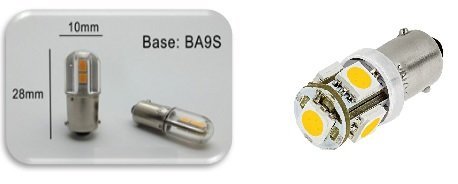
Here is a picture of the 2-way (4 LEDs total) and another of the 5-way (5 LEDs total).
ba9s_image 2-way and 5-way.jpg
you mentioned that what the camera shows and what you see on the clock is a bit different
That I mentioned before discovering the camera's ProMode. With that I manually adjusted the ISO/WB/Shutter Speed until the display on my camera matched what I was seeing when looking directly at the gauges. I then took photos and was content they were representative to what I was seeing.
The above photos are pretty much what I see.

interesting how different the tach looks compared to the other gauges
Yep and that is what I am seeing. It has a warmer light but using the same bulbs as both neighboring gauges in 2nd photo.
The tach's glass is noticeably a bit dustier on the inside - I may remove and clean it to see if the dust is somehow filtering the light color.
But today I'll open the multi-gauge and have a look around.
 
Back
Top