rblongboarder
Well-Known Member
This summary of 70s and 80s BMW engine development is quite interesting:
There's a statement which caught my attention:
"For the 1976 season, the oil crisis was a few years back and BMW decided to enter the newly created group 5 series. By request of the factory, Josef Schnitzer further developed the M49 engine so it could be used for vertical installation in the CSL's engine bay. Vertical installation allowed the use of larger exhaust headers, a more optimized inlet system and the installation of a more efficient cooling system.
This engine was named M49/3 and yielded 465hp @ 8500RPM. But compared top the Porsche 935 turbo, the E9 CSL with the atmospheric M49/3 engine did not have a chance to compete. That is why in a later stage, twin turbo chargers where added. This was the fifth evolution of the M49 engine and was called M49/4...
The four-valve M49/4 engine allowed a relatively low turbo pressure. Usually, a boost of 1.3bar was used to yield a neat 750hp @ 9000RPM. This high power output came with a relatively high reliability of the engine. Although the CSL gearbox was not designed for such a power, it held up rather well during the races."
The twin turbo M49/4 engine is featured in this video link:
Interesting fact from 7:25 of the video.
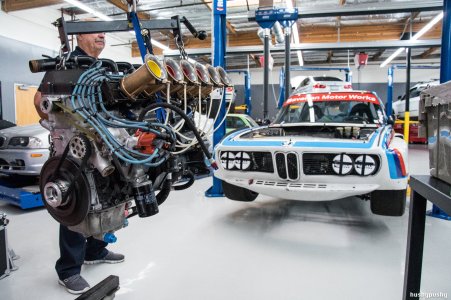
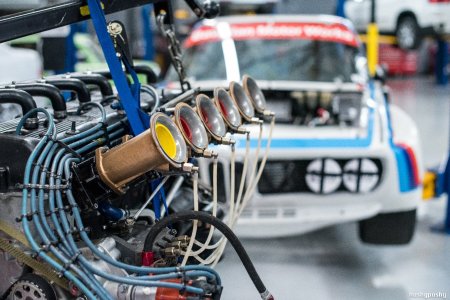
Mechanics pack a sports turbocharged inline-6 with 800 horsepower into the engine bay of an E9 CSL designed
by Frank Stella from the BMW Art Cars series that raced in the LeMans endurance race.
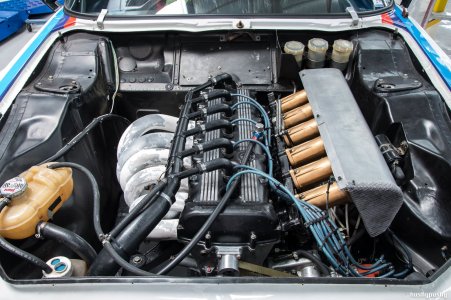
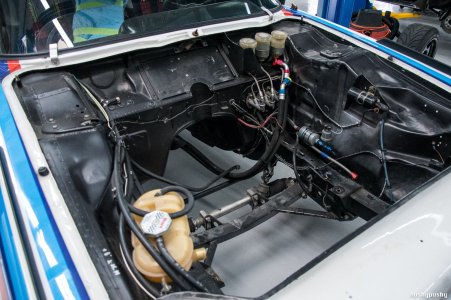
I always thought the M30 engines were tilted about 20-30deg to the passenger side in order to provide clearance for the hood. The vertical height of the commercial M30 oil pan & oil pump could potentially introduce clearance issues on the bottom side, but with a low-profile, dry sump oil pan for racing.. the overall vertical engine profile is reduced by several inches.
Out of curiosity.. does anyone have a historical photo of the vertically-mounted CSL engine? That's an interesting piece of history.

Here is a useful reference on engine variants and dimensions
There's a statement which caught my attention:
"For the 1976 season, the oil crisis was a few years back and BMW decided to enter the newly created group 5 series. By request of the factory, Josef Schnitzer further developed the M49 engine so it could be used for vertical installation in the CSL's engine bay. Vertical installation allowed the use of larger exhaust headers, a more optimized inlet system and the installation of a more efficient cooling system.
This engine was named M49/3 and yielded 465hp @ 8500RPM. But compared top the Porsche 935 turbo, the E9 CSL with the atmospheric M49/3 engine did not have a chance to compete. That is why in a later stage, twin turbo chargers where added. This was the fifth evolution of the M49 engine and was called M49/4...
The four-valve M49/4 engine allowed a relatively low turbo pressure. Usually, a boost of 1.3bar was used to yield a neat 750hp @ 9000RPM. This high power output came with a relatively high reliability of the engine. Although the CSL gearbox was not designed for such a power, it held up rather well during the races."
The twin turbo M49/4 engine is featured in this video link:

Interesting fact from 7:25 of the video.
Mechanics pack a sports turbocharged inline-6 with 800 horsepower into the engine bay of an E9 CSL designed
by Frank Stella from the BMW Art Cars series that raced in the LeMans endurance race.

I always thought the M30 engines were tilted about 20-30deg to the passenger side in order to provide clearance for the hood. The vertical height of the commercial M30 oil pan & oil pump could potentially introduce clearance issues on the bottom side, but with a low-profile, dry sump oil pan for racing.. the overall vertical engine profile is reduced by several inches.
Out of curiosity.. does anyone have a historical photo of the vertically-mounted CSL engine? That's an interesting piece of history.
Last edited: