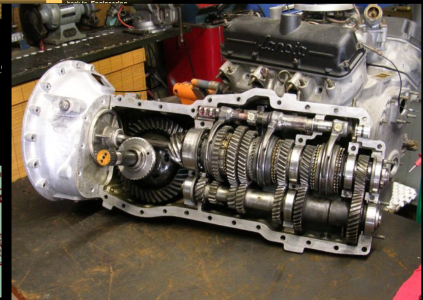
And educational tools!!I am not ambitious enough to attempt a rebuild! I was given a bad trans to rob the shift rod. It was fun to take apart, now I have spare parts.

And educational tools!!I am not ambitious enough to attempt a rebuild! I was given a bad trans to rob the shift rod. It was fun to take apart, now I have spare parts.

If nothing else I'm glad at least 1 other person in this world geeks out with mechanical things like I do.And educational tools!!


The helical gears are always engaged. The selectable gears (1 through 5) are mounted to the output shaft on roller bearings. So, they ordinarily just spin on the shaft. They are always engaged with their counterpart gears on the lay-shaft, and so, if the input shaft is spinning, each of the selectable gears is spinning at a speed related to the gear ratio.That is a useful analysis and picture Scott. Two intriguing questions remain in terms of the details, 1) how does the non-linear motion (H pattern) of the shift lever gets translated into a linear and gradual displacement of what you call shifter in the picture; 2) the gear helicoidal teeth on the right, do they engage/disengage when shifting, or are they always engaged but they get attached/detached from the shaft and that is all?
When I fail a shift and hear the dreaded gear impact noise, I always imagine gear teeth not meshing, but it is perhaps dog clutch teeth making that noise.
Yes, For a 5 speed there are actually 4 shift rods. One for reverse, one for 5th, and two for the 1-2-3-4 H-pattern.That is what I suspected for practical reasons. Helical gears are coupled at the factory, no play, no need to engage ever again.
That makes the role of the roller bearings hugely important, if they ever start developing friction then it is as if you are driving on two different gears at the same time... Imagine you are in 5th gear but the second gear roller has 50% friction, it effectively causes your own engine to operate as a brake towards the driveshaft, as if you kind of downshifted. It would be noisy and develop some heat I guess.
I assume a transmission rebuild starts with replacing all roller bearings...
Now I get the shift rods and why the H pattern.
Lateral motion selects which rod, back and forth determines towards which gear it moves.
Interesting.. I am wondering if the input shaft goes through the output shaft, making the input gear the one on the far right.Fascinating, here is an open transaxle for a FWD car. Still 5-speed. The straight cut gears on the left are presumably reverse, and then 1st through 5th in sequence to the right. The notable part is that the input and output face the front of the car so presumably the shafts are one inside the other with a bearing or more in between...
Not sure.Interesting.. I am wondering if the input shaft goes through the output shaft, making the input gear the one on the far right.

 metricmechanic.com
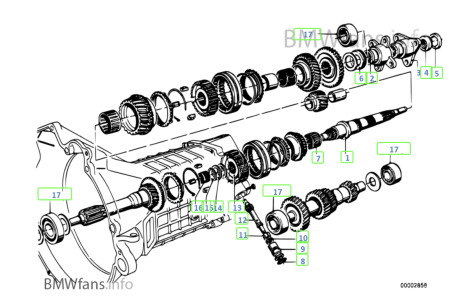
In any condition if the engine is running and clutch not depressed three of the roller bearings are spinning... they can never be separated from each other....Nice drawing and description. Let's now derive a noise throubleshooting guide based on that.
There are 4 bearings to consider, let's designate them UL, UR, LL, and LR based on their location in the diagram Ignoring their real names for now).
1) Transmission is in neutral, car idles, no motion, clutch pedal depressed: No bearings can be making any noise because none should be spinning.
2) Transmission is in neutral, car idles, car rolling forward, clutch pedal depressed: The only bearing that moves is UR, if we hear noise that one is bad. No noise means UR is good.
3) Transmission is in neutral, car idles, no motion, clutch pedal released: UL, LL, LR are spinning but UR is not. Bearing noise can be any of the three. Noise should be proportional to RPM.
4) Transmission is in forward gear, car idles, car rolling forward, clutch pedal depressed: All bearings should spin and any noise should be proportional to road speed and independent of engine RPM.
5) Transmission is in gear, car accelerated, clutch pedal released: All bearings are spinning, UL, LL, LR proportional to RPM, UR proportional to road speed.
Based on the above it is hard to know which of the UL, LL, LR is noisy unless the load is a factor.
Okayreally the only noise that is fairly easy to diagnose is the input shaft bearing. With the car in neutral, if you release the clutch, you may be able to hear the input shaft spinning.
Trying to hear the other bearing seems like a waste of time, since as soon as the clutch is released all of the gears are spinning except the aft output shaft bearing.
Some heavier oil might help for a bit. Sawdust is known to quiet them !Okay
So I drove my car again this weekend.
The only quiet gear in the 5 speed gearbox is 4th gear
All of the others are winey
With the engine running and the gearbox in neutral she sounds rattely and when I press in the clutch,that noise goes away.
As I bought the gearbox second hand it was a bit of an unknown . So for now I might see if putting different oil in or something might help