Original Carburetor replacement on original engine and injection engine?

tom

Member
Messages
21
Reaction score
0
Location
Germany
Hello, Tom from germany speaking/Asking basically 2 Questions:

1) Has there anyone replaced the original carburetors on a 3.0 CS (1972) by some different carbs but with untouched Engineblock/head/crankshaft/pistons...?

Is there a substitution carboretor kit existing which works after installing / adjustment without modifying anything else?
(i´m not seeking for more power - if there will be 5,10 PS more - fine, if same as old fine too)
Head# 1250019 (9) Block: (i think its xx 446)

2) When having a different engine (Head/ Engineblock of the 3.0SI injection e3 e9) which caburetor set would work here without touching Engineblock/head/crankshaft/pistons? (only removing the injection itake manifold and replace by Carbs) maybe just mod the fuel pump external instead the mechanical attahced to 019 head
the head number is 1277358 + Block 753L A 12 01

Does anybody have done this "modification" / exchange and what are the exact Products (+ numbers) used?
(What did maybe not work -> experiences highly appreciated)
Thank you, Tom
 

Attachments

  • i.jpg
    i.jpg
    372.4 KB · Views: 41
If I understand your question #1 correctly, the answer is "yes". Many e3/e9 owners have exchanged their original Zenith carburetors for Weber 32/36 DGV series carburetors. The Webers will bolt onto the original BMW carburetor manifold. Note that Weber 32/36's are available in three versions: manual (e.g., cable) (DGV), coolant (DGAV) or electrically (DGEV) -operated chokes. Some fiddling with the throttle linkage is required when switching from Zeniths to Webers to prevent over-centering at maximum throttle.

The Webers won't give you any additional power and many owners feel that a properly tuned Zeniths are better for fuel mileage and smooth operation.
 
Last edited:
Also, Carl Nelson used to recommend the Weber 38/38 downdraft carburetors as an alternative to the 32/36s.

I had 32/36 DGAVs on my car when I bought it. They do not require any modifications to the engine, but you need a pair of mounting blocks to mount the carbs to the intake manifold and a pair of air filter adapters in order to attach the stock air cleaner. And, of course, you will need to modify your linkage. I believe a pair of 38/38s would require these same changes.

If you are starting with an engine that had fuel injection, you need a fuel pump that is appropriate for the carburetors. I have Weber sidedrafts, but my fuel pump would be appropriate for downdrafts as well. https://e9coupe.com/forum/threads/adding-a-electric-fuel-pump-suggestions.42221/post-369474
 
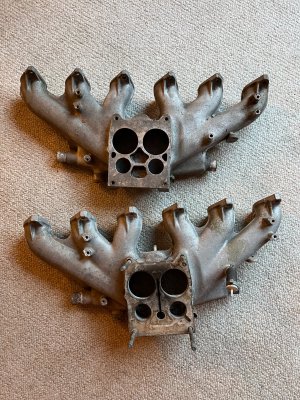
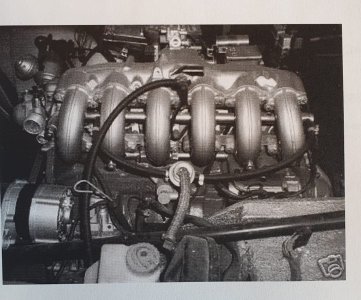
I went a step further and found a single four-barrel manifold from a euro model M30 and adapted a Rochester Quadra-jet to it for my M30B35 motor. Much simpler to work with than two carbs. No synchronizing, no linkage adjustment issues, great throttle response, readily available performance parts and unique in its application.

Q-jetBNW.JPG
 
You should be aware of a few key points. The carbureted heads have a provision for a mechanically driven fuel pump. So if you are converting a csi head to carbs you will need an electric fuel pump. Other than that the csi and carb heads are the same. You need to be careful if changing to a different head (B34/35, etc) since the combustion chambers are not all the same. You will need the appropriate intake manifold and throttle linkage for whatever carbs you use. I am adapting an M90 engine to use triple Weber side drafts, and that requires a unique manifold and linkage. The air filters are substantially different between CSi and down draft carbs. Depending on the combination of head and manifold you may need to do some porting, since the size and shape of the intake ports is different with different heads. Not really an issue if you are using a stock 3.9 head
 
I went a step further and found a single four-barrel manifold from a euro model M30 and adapted a Rochester Quadra-jet to it for my M30B35 motor. Much simpler to work with than two carbs. No synchronizing, no linkage adjustment issues, great throttle response, readily available performance parts and unique in its application.

View attachment 219704
That’s a unique solution!!
 
I've heard of the euro intake that allows single American carbs to be used, but how/where does one get such a thing? They must be DECADES old across the pond and with increasing taxes on older cars, many old M30s would have gone to their just reward (or simply melted away in place).

@MikeGoble -
I don't see a mechanical fuel pump, so you must be using an electric unit? Powered from a connection to the coil, or elsewhere?
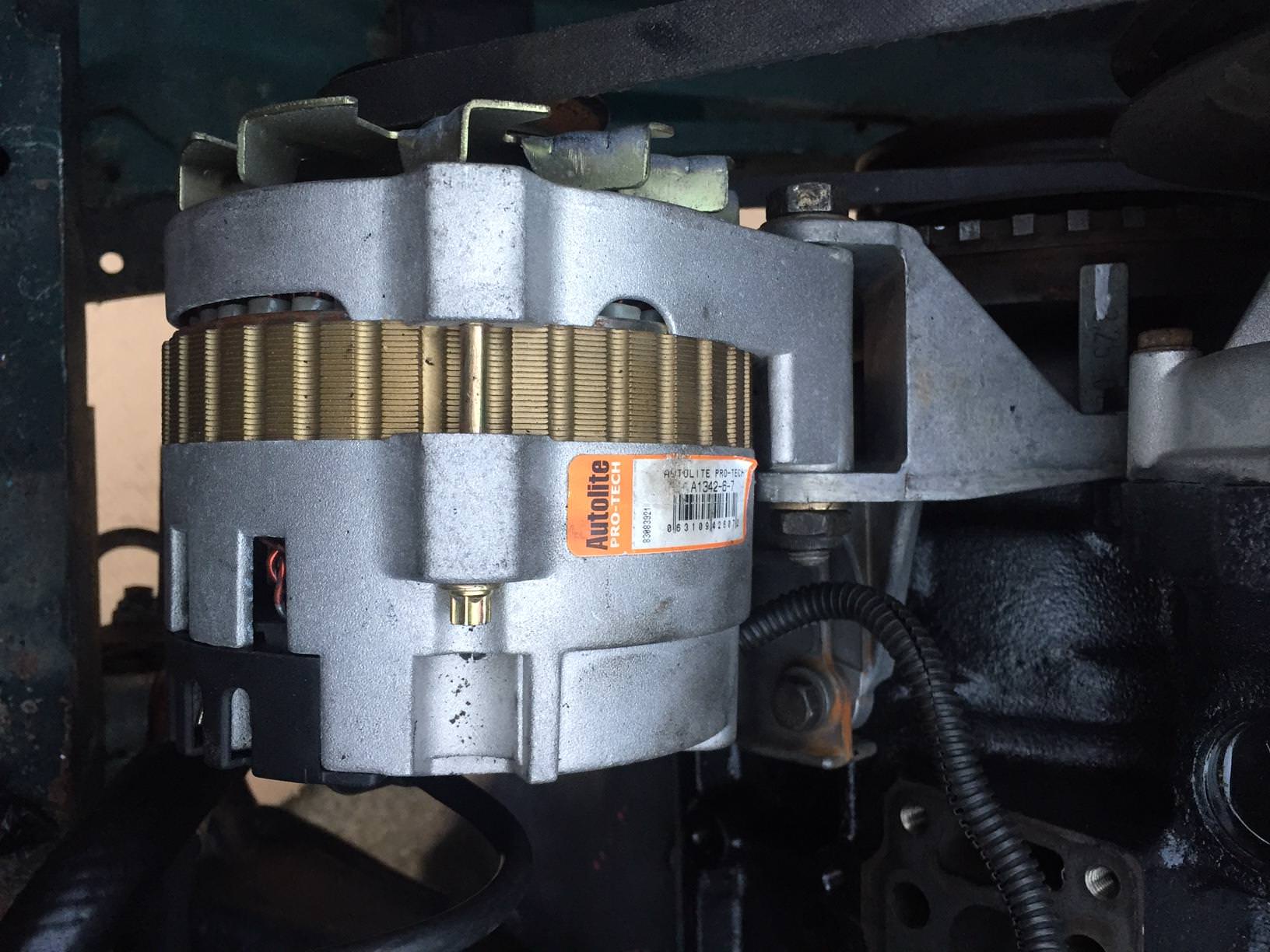
Voltage regulator supplanted by an alternator with internal regulator?
Is the strap connected to the rear manifold port bolt the engine ground strap and connected to the firewall? I've been having electrical difficulties and I think my strap is AWOL.
Is your breather hose from the valve cover vented to air below the engine? I "understood" that the engine runs better (rings seal better, somehow) if the crankcase is under slight vacuum.
Looks like the manifold vacuum port on the rear cylinder intake is routed to the distributor, a vacuum gage, and something else at the rear of the engine compartment - what? No connection to the brake booster?

Inquiring minds (mine, anyway) want to know, PM if you think this stuff is off topic, thanks. I may be in Munich again later this year (O'fest again) and could have a chance to find such a manifold. I've kind of had it with Zeniths.
 
Charlie -

As to ground straps, I am a big fan. I not only have the ground strap to the body at the rear of the engine, I've added a ground cable from the alternator to the block at the oil filter, along with a ground cable from the filter mount location to the battery ground at the front fender.

On the intake manifold, you should consider reaching out to Al Taylor ([email protected]). I know Al ran this manifold/carburetor setup in one of his race cars.
 
I've heard of the euro intake that allows single American carbs to be used, but how/where does one get such a thing? They must be DECADES old across the pond and with increasing taxes on older cars, many old M30s would have gone to their just reward (or simply melted away in place).

@MikeGoble -
I don't see a mechanical fuel pump, so you must be using an electric unit? Powered from a connection to the coil, or elsewhere?
Voltage regulator supplanted by an alternator with internal regulator?
Is the strap connected to the rear manifold port bolt the engine ground strap and connected to the firewall? I've been having electrical difficulties and I think my strap is AWOL.
Is your breather hose from the valve cover vented to air below the engine? I "understood" that the engine runs better (rings seal better, somehow) if the crankcase is under slight vacuum.
Looks like the manifold vacuum port on the rear cylinder intake is routed to the distributor, a vacuum gage, and something else at the rear of the engine compartment - what? No connection to the brake booster?

Inquiring minds (mine, anyway) want to know, PM if you think this stuff is off topic, thanks. I may be in Munich again later this year (O'fest again) and could have a chance to find such a manifold. I've kind of had it with Zeniths.

1. I use the VDO pre-supply pump from an E28. It fits into the E3 tank nicely and the sending unit wires right up. It puts out about 3# of fuel pressure which is very adequate for a Q-jet. It's powered by a relay that is controlled by ignition power and an oil pressure switch that will kill the pump when the oil pressure is lost. I have a bypass switch so I can prime the carb if it needs it.
2. That's an AC Delco CS-130 alternator. I have posted a couple of threads about installing one.
3. Yes, that is a grounding strap from the block to the firewall. I have other ground straps as well, connecting the block/trans to the frame. It's difficult to have too many grounds.
4. My breather hose ends in a vented can down by the PS pump. I have used vacuum pumps on several engines and to get a proper vacuum seal you have to spend a bit of time sealing the leaks in the engine. Everything leaks - the distributor, the main seals, the corners of the gaskets, anything under crankcase pressure. I have an air compressor that I converted into vacuum pump just for leak testing, and when I hooked it up to my M30 the whistling noises from various places on the engine made it obvious that sealing the engine would be quite a chore. I've dyno tested engines to see the effect of the reduced windage attributable to moderate ( 6-7 inhg ) crankcase vacuum and it's quite real. One item you need is an oil recovery system to return the oil sucked out by the vacuum pump back to the crankcase. A PCV system is not effective at creating sufficient vacuum to reduce the crankcase windage.
5. The brake booster is connected to the baseplate of the carburetor, a standard port on every Q-jet. The vacuum port on the manifold is connected to the vacuum advance and a gauge in my dash. I run full manifold vacuum to the VA can because that's what works best. More advance at idle means cooler running. Here's an interesting article written by a GM engineer many years ago about the function of vacuum advance.

I have two more of the euro 4-bbl manifolds. I bought one for my Nova wagon and the other one just showed up. Adapting a Q-jet isn't a very difficult task. It requires making a 2-piece adapter plate to install between the 4A1 mounting pattern and the Rochester baseplate and some linkage creation. You will need to be creative with the cooling system hoses. I went to my local boneyard and grabbed hoses from various cars that looked like they might fit and adapted them.
 

Attachments

  • IMG_2764.jpeg
    IMG_2764.jpeg
    676 KB · Views: 5
Back
Top