

I was working through a carburetor issue last week. After a long period of calm and smooth running, my Coupe suddenly would stall at a stop light. I am sensitive to that as this is an automatic and I had it dialled in to perfection, at a stop, in gear, it was idling fine, perhaps even as low as 550 rpm, but it did not matter, idle was strong, stable, and shifts from 2-1 were gentle. Not like when you must dial in a higher idle rpm to keep the car from stalling. This was set up great. Got it home and diagnosed a flooding front carb. (I have a pair of Weber 32/36s). Went through the usual measures, cleaning out all passages, adjusting float, replacing float, new needle valve and seat, new power valve, carb top off, then back on, over and over, ...until the progress bar of my "Fed-up" metre reached 100%.
Time for nuclear option. I had purchased a new Weber from Pierce Manifolds 4 years ago, for just this scenario. After 40 years, perhaps it was time to change to a new unit. Swap went well, except that overnight, one of the blocked off water hoses did leak and ran coolant out to below bottom of expansion tank. Was hopeful air did not get in. Filled tank. Time for a test drive. Car started great. Took drive, seemed to get hot pretty quick. Made one stop, then car was difficult to restart. Not normal. Drove home to investigate.
Next day I thought I would start with purging air from cooling system...and...this is where things got interesting. During the process, as car was running and heater was on full, and I was watching for the tiny bubbles of air escaping from the bleed screw, I observed, over by the ignition coil, smoke! Smoke, plus atomized oil...my coil was literally being boiled! Shut down immediately, disconnected battery.
I have owned this car 38 years. Ignition system has operated fine. It has always had a Crane XR700 electronic ignition. On that day, it died. A transistor failed, and it became permanently grounded and sent all its voltage into the poor coil and did not ever stop. Usually it is a pulse to assist in startup, but that day it seized.
What to do? Fast now makes the very same unit, and it is a virtual plug a play swap. But cannot get this in my hands quickly. I know Pertronix is popular, but again, there may be a delay. Add to that, the need to acquire a specific ignition coil....have you seen the prices now for a Bosch Red?
Decision time. I decided to rip out old Crane, revert to new set of points, condenser, rotor, cap, swap out coil with known good Bosch Black with factory spec Primary and secondary values. Car started and runs great again. I must say, it always helps to have spares on hand, especially as what used to be readily available ignition parts are now special order or days away, as well as much more expensive!
So, just when everything was going so well.....ah, the joy of owning/driving a 54 year old car. Mike
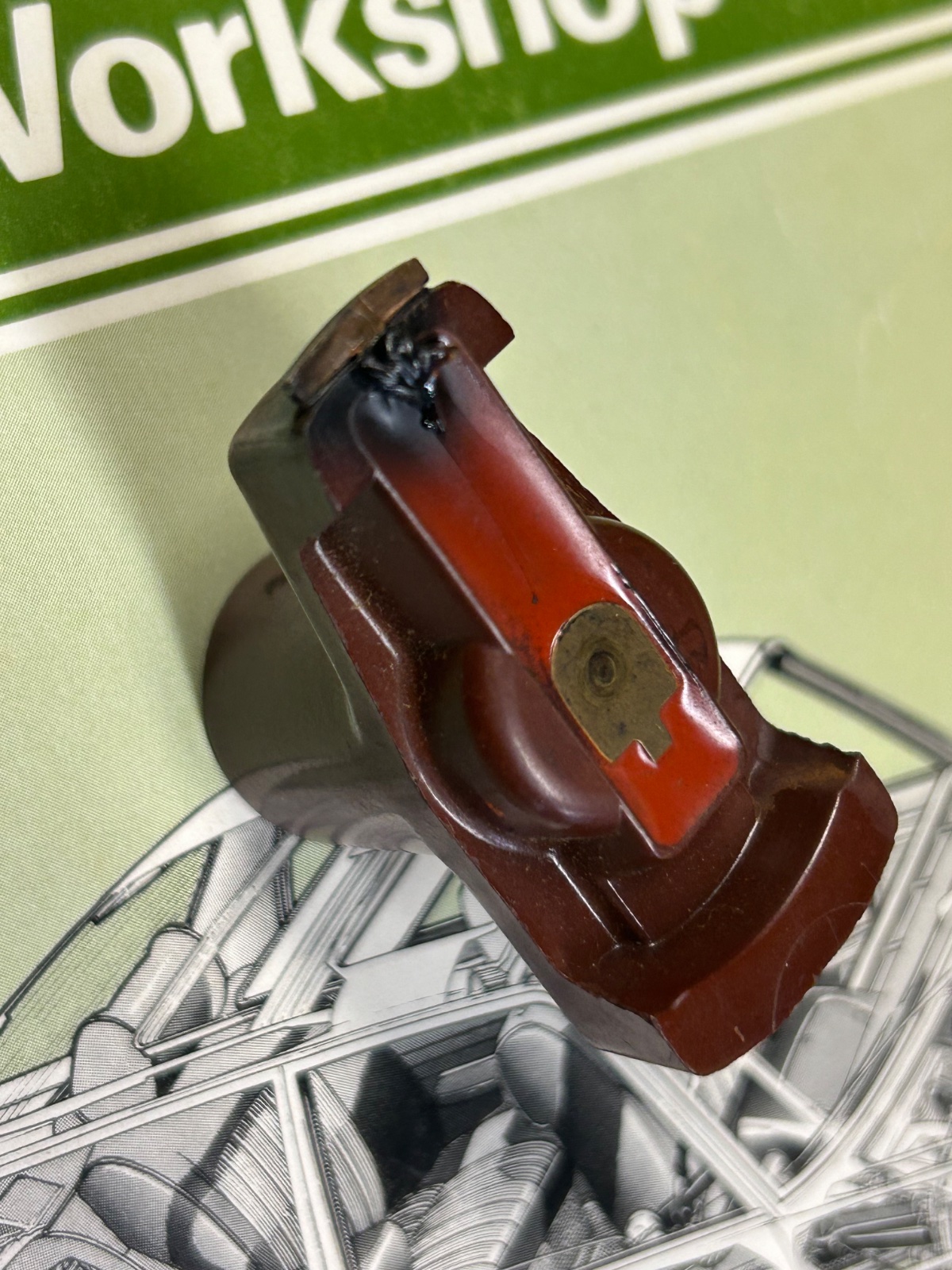
You should have a look at the rotor :
Time for nuclear option. I had purchased a new Weber from Pierce Manifolds 4 years ago, for just this scenario. After 40 years, perhaps it was time to change to a new unit. Swap went well, except that overnight, one of the blocked off water hoses did leak and ran coolant out to below bottom of expansion tank. Was hopeful air did not get in. Filled tank. Time for a test drive. Car started great. Took drive, seemed to get hot pretty quick. Made one stop, then car was difficult to restart. Not normal. Drove home to investigate.
Next day I thought I would start with purging air from cooling system...and...this is where things got interesting. During the process, as car was running and heater was on full, and I was watching for the tiny bubbles of air escaping from the bleed screw, I observed, over by the ignition coil, smoke! Smoke, plus atomized oil...my coil was literally being boiled! Shut down immediately, disconnected battery.
I have owned this car 38 years. Ignition system has operated fine. It has always had a Crane XR700 electronic ignition. On that day, it died. A transistor failed, and it became permanently grounded and sent all its voltage into the poor coil and did not ever stop. Usually it is a pulse to assist in startup, but that day it seized.
What to do? Fast now makes the very same unit, and it is a virtual plug a play swap. But cannot get this in my hands quickly. I know Pertronix is popular, but again, there may be a delay. Add to that, the need to acquire a specific ignition coil....have you seen the prices now for a Bosch Red?
Decision time. I decided to rip out old Crane, revert to new set of points, condenser, rotor, cap, swap out coil with known good Bosch Black with factory spec Primary and secondary values. Car started and runs great again. I must say, it always helps to have spares on hand, especially as what used to be readily available ignition parts are now special order or days away, as well as much more expensive!
So, just when everything was going so well.....ah, the joy of owning/driving a 54 year old car. Mike
You should have a look at the rotor :
Last edited:


 Good sleuthing and I'm glad it's back on the road.