2800 CS brake problem

gwittman

Well-Known Member
Messages
483
Reaction score
91
Location
Costa Mesa. CA
I can't get my Coupe on my lift right now but thought I would describe what happened to see if anyone has a good idea what happened. I was driving from Huntington Beach to Costa Mesa on the 405 freeway. As I got close to Costa Mesa, I felt a little vibration like a wheel slightly out of balance. I slowed a little because I remembered I had not retorqued the lug nuts since installing new front suspension bushing. The vibration did not get any worse, so I continued at a slower pace.

Then, I began to smell friction material burning and thought someone must be burning their brakes or clutch. The smell stayed with me as I continued on, and I began to wonder if it was coming from my car. I felt no dragging resistance so I didn't think it could be my car. Eventually, I had to use my brakes, and it pulled to the right. That is when I realized it must be my brakes that I am smelling. I slowed even more but did not want to stop on the shoulder of the freeway. I came to an exit pretty quick and tested my brakes to see if I could trust them. I also had my hand on the parking brake in case I needed that. The brakes began to work but slowly the pedal stared to compress to toward the floor. I then used the hand brake to slow the car more.

I creeped to a safe place to stop at a parking lot. Once stopped I stepped on the brake pedal again and it went all the way to the floor. There was some resistance but the second time no resistance. I tried pumping but it would not pump up. I got out and looked at the brake fluid reservoir, and it was full. I looked under the car for any sign of fluid leakage and found no sign of leakage. There was some smoke drifting out, but I could not tell which side it was coming from. I checked both front wheels to see if they were hot and neither was excessively hot. I could not tell for sure, but both rotors appeared to be slightly blue.

I didn't have far to go so I drove slowly home using my parking brake and first gear for slowing and stopping. I made it without any problems. It is now parked in the garage waiting to get on the lift.

I thought our Coupes had a dual brake system. So, I either had a catastrophic master cylinder failure, or I don't have a dual brake system. I can't quite figure out how a master cylinder could apply the brakes while drive down a freeway without the use of the brakes. I replaced the flexible brake lines around ten years ago when one had the interior collapse. It did not have the same symptoms as I experienced this time. I think they are new enough that they would not be the cause.

I rebuilt the calipers about three/four years ago when I installed new brake pads. I doubt they would be sticking and would lose fluid if they failed when the pedal went to the floor. I believe they are not the problem. That leads me back to the master cylinder as the only thing left to consider as the failure. I hope they is still available or there is a rebuild kit for it.

Any ideas as to what else could be the problem?
 
do you still have the rear drums? those can drag if one of the shoes gets out of alignment. so did you smell the issue in the front or rear of the car ... or just everywhere?
 
do you still have the rear drums? those can drag if one of the shoes gets out of alignment. so did you smell the issue in the front or rear of the car ... or just everywhere?
I do have rear drums, but I am sure the front brakes that were dragging. That is where the smoke was coming from. The smell seemed to be more concentrated i the front too.
 
Measuring the temperature of each wheel would’ve helped
Yes, that would have helped. I did touch both front wheels and they were pretty much the same temperature, and I would estimate both under 150F. I think that is hotter than normal for the driving I was doing, but not excessively hot. I did not check the rear drums because the issue was convincingly in the front.
 
I rebuilt the calipers about three/four years ago when I installed new brake pads. I doubt they would be sticking and would lose fluid if they failed when the pedal went to the floor. I believe they are not the problem.
I know you are confident that the calipers are OK, but one scenario that would explain your symptoms is a stuck caliper that doesn't allow the pad or pads to withdraw, causing friction, heat, odor, smoke. Another scenario is an old brake flex hose that is internally swollen and acts as a one-way valve, pressurizing the caliper when the pedal is depressed, but not allowing that pressurized fluid to return to the MC. Regardless of its cause, that heat may have boiled the fluid in the caliper, causing the pedal to drop to the floor. Even a dual circuit system would be susceptible to that, as fluid in both circuits would boil in that caliper. Does the pedal still go to the floor now that the car has cooled down? If so, does pumping the pedal do anything?
 
Last edited:
Complete loss of pressure without fluid loss is a master cylinder or possibly a booster.

But check all the lines and the rear wheels cylinders to make sure no fluid is escaping
 
I’m with Jay. How are your flexible brake lines? I’ve seen flex hoses that look fine but are clogged. Stuck brake caliper pistons and/or a collapsed/clogged flexible brake hose can cause brake fluid to boil. Once your fluid reaches a boiling point it loses its hydraulic abilities and your pedal will go to the floor. When it cools your pedal will feel normal again. Collapsed or clogged flex lines apply continuous friction heat by keeping the brake pad pressed against the rotor this causes the fluid to heat up. A collapsed rubber hose acts like a one-way check valve, trapping pressure in the caliper even when you let go of the brake pedal.
 
Last edited:
Despite the best of intentions, brake fluid can become contaminated with water, especially in very humid/rain prone climates and with frequent engine bay washing. (Like it or not, some 50-year-old reservoir caps may have significantly more venting . . . than intended.) Original equipment rubber flex brake hoses are generally long lived, but that does not mean it is impossible for one to fail. They typically bear a manufacture date on the exterior. But even a date can be misleading if they are poorly stored.

This may be a shot in the dark, since I can't recall any personal experience with this. Potential issues with brake fluid and flex hose integrity brings to mind any interplay with the “brake pressure proportioning valve” and the "pre-pressure valve" pn: 34314650332 ordinarily found on models with rear drum brakes.

https://e9coupe.com/forum/threads/rear-brake-pressure-regulating-valve-rebuild.43122/#post-401652


https://www.mgaguru.com/mgtech/hydraulics/ht104c.htm

img_5845-jpeg.169610
iu

iu
 
I know you are confident that the calipers are OK, but one scenario that would explain your symptoms is a stuck caliper that doesn't allow the pad or pads to withdraw, causing friction, heat, odor, smoke. Another scenario is an old brake flex hose that is internally swollen and acts as a one-way valve, pressurizing the caliper when the pedal is depressed, but not allowing that pressurized fluid to return to the MC. Regardless of its cause, that heat may have boiled the fluid in the caliper, causing the pedal to drop to the floor. Even a dual circuit system would be susceptible to that, as fluid in both circuits would boil in that caliper. Does the pedal still go to the floor now that the car has cooled down? If so, does pumping the pedal do anything?
Bingo
 
jmackro was partially correct on my issue. Even though I did not have any leaks initially, I had a lot of brake fluid on the garage floor under the left caliper two days later. That helped me to remember when I installed the pads, I bought a rebuild kit and decided to just replace the outer rubber caps because they were deteriorated. The brakes were still functioning very well. That turns out to be a bad decision. I did find one frozen piston in the left caliper. The right one was still free and not leaking.

I have experienced a flexible brake line collapsing on the inside and replaced them. That was very different than what I experienced this time.

I am now rebuilding both calipers, replacing both rotors and installing new pads. I will then do a complete bleed and make sure the master cylinder is functioning properly.

I still don't understand how overheating the caliper can cause the dual brake system not to work. I had a piston freeze on my race car during a cool down lap. I could feel it dragging but felt I could get back to impound without have to be towed. I did make it to the impound entrance but that was it. The car came to a full stop. The pad got so hot is welded itself to the rotor. Amazingly, I still had a firm race pedal, and the dual brake system was functional.

I am hoping the BMW master cylinder was not the original issue the caused the calipers to drag and heat them so much to cause one piston to freeze. I should be able to determine that once everything is newly assembled and bled.
 
I still don't understand how overheating the caliper can cause the dual brake system not to work. I had a piston freeze on my race car during a cool down lap. I could feel it dragging but felt I could get back to impound without have to be towed. I did make it to the impound entrance but that was it. The car came to a full stop. The pad got so hot is welded itself to the rotor. Amazingly, I still had a firm race pedal, and the dual brake system was functional.
What don't you understand?

- How a gas (like steam) would be compressible, but a fluid (like a brake fluid/water mix) would not?
OR
- How a hot caliper could cause both of its brake circuits to boil?

I think that bengal taiga provides some insight in post #9 where he writes: "Despite the best of intentions, brake fluid can become contaminated with water, especially in very humid/rain prone climates and with frequent engine bay washing". Your competition car probably had its brake fluid changed regularly, so it had little water content. Your street car may have had a higher proportion of water, which allowed it to boil when the caliper got hot (pure brake fluid has a higher boiling point than water).

Admittedly I am just speculating on what caused your braking issues. But I'll bet that your rebuilt calipers, new pads and new rotors will resolve problem, regardless of its cause. If it were me and I was doing all that, I would replace the flex hoses too "while I was in there", but that's your call.
 
Rubber brake lines usually deteriorate inside/out. They may look fine on the outside but have collapsed on the inside. Brake fluid is hydroscopic and draws in moisture. This process is exacerbated by the heat cycling of the brake calipers and cylinders. When the fluid cools it draws in the moisture from the atmosphere. Once the moisture is contained in the fluid it deteriorates the lines, both rubber and metal and causes the calipers and cylinders to corrode internally.

When the brake fluid is contaminated it can cause a soft pedal and when heated (boiling the brake fluid) can cause air in the lines with the worst case scenario of no brake pedal at all. The moisture in the fluid lowers the boiling point of the brake fluid.

Also, when bleeding the brakes, you need to start with the wheel furthest from the MC. Right rear, left rear, right front and then left front to make sure there isn't any air in the brake lines.

I live in Florida and on my street vehicles I flush the brake fluid annually and on my race car we do a brake bleed and flush after every race weekend at a minimum.
 
Last edited:
What don't you understand?

- How a gas (like steam) would be compressible, but a fluid (like a brake fluid/water mix) would not?
OR
- How a hot caliper could cause both of its brake circuits to boil?

I think that bengal taiga provides some insight in post #9 where he writes: "Despite the best of intentions, brake fluid can become contaminated with water, especially in very humid/rain prone climates and with frequent engine bay washing". Your competition car probably had its brake fluid changed regularly, so it had little water content. Your street car may have had a higher proportion of water, which allowed it to boil when the caliper got hot (pure brake fluid has a higher boiling point than water).

Admittedly I am just speculating on what caused your braking issues. But I'll bet that your rebuilt calipers, new pads and new rotors will resolve problem, regardless of its cause. If it were me and I was doing all that, I would replace the flex hoses too "while I was in there", but that's your call.
I am a chemist and understand how liquids can become a gas and compressible. I also understand brake fluid does not need water in it to boil, water just lowers the boiling point. I do not understand how a hot caliper can cause both brake circuits to boil. I read the description in my Blue book on how the brake dual master cylinder works. They are isolated systems and gas in one side of the dual brake system should not affect the other side of the system. The pedal might get soft, but it should not go all the way to the floor with no braking at all. I am sure you understand the purpose of the dual brake system is to still have partial brakes when one part of the system fails.

I hope you are right about rebuilt calipers, new pads and new rotors resolving the problem. That is what I am hoping for. I really don't want to deal with the master cylinder unless I have to. Since I have already replaced the flex lines, I don't think that is part of the problem, but I will consider it.
 
I do not understand how a hot caliper can cause both brake circuits to boil. I read the description in my Blue book on how the brake dual master cylinder works. They are isolated systems and gas in one side of the dual brake system should not affect the other side of the system. The pedal might get soft, but it should not go all the way to the floor with no braking at all. I am sure you understand the purpose of the dual brake system is to still have partial brakes when one part of the system fails.

If fluid in only one of the car's two circuits were boiling, then yes, the pedal might get soft, but not go all the way to the floor. But since both circuits feed the front calipers, if a caliper gets hot enough to boil one, then it's going to boil the other as well. So my assumption is that you had gas in both circuits while the caliper was hot.
 
The primary circuit in a dual master cylinder works the front brakes which do 70-80% of the braking in a typical road car. If you over heated the front brakes, which you stated were blue in color, an indication of overheating, then it is possible you boiled the brake fluid. As a result the primary circuit would have air in the system from the gassing off of the fluid/moisture rendering that circuit potentially useless. Depending on the the adjustment and condition of the rear drum brakes and cylinders 20-30% is all you would have to stop the car in optimal conditions. What is the condition of the rear brakes?

I am purely speculating on the problem, without seeing the car in person it is difficult to pinpoint the issue.
 
Last edited:
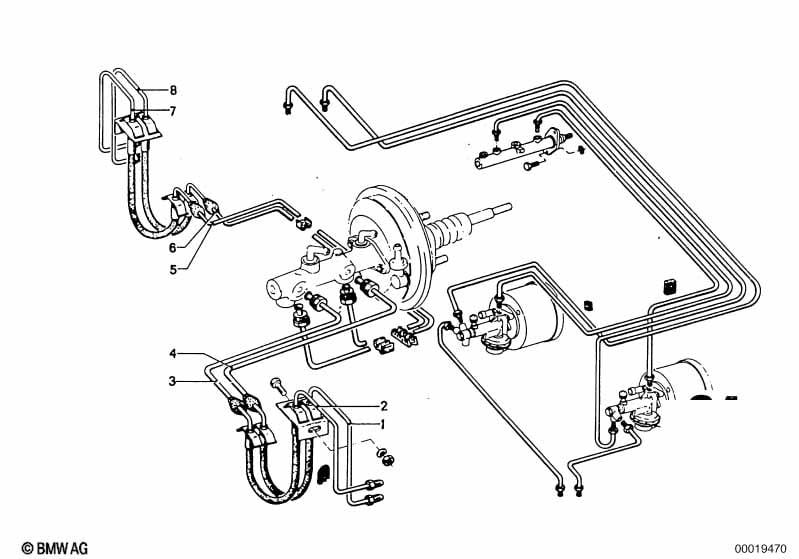
diag_f0u.jpg


I forgot that the brake system has two brake lines to each front caliper. If you look at the diagram above you can see that brake lines (3-4 and 5-6) for the front calipers route a line to both the primary and secondary circuits on the MC. If that's the case then overheating the front brakes and overheating the brake fluid can compromise both the primary and secondary circuits of the brake system.
 
That diagram explains what happened to my brakes. I knew there were two lines going to each front caliper, but I am used to dual brake systems separating front and rear brakes. I had a suspicion the two caliper lines were for the two separate dual brake systems but thought that is not a good idea because of what happened to me. The dual brake system is supposed to prevent total hydraulic brake failure. I just happened to find the way this dual brake system still results in total brake failure. Fortunately, I still had the parking brake to slow me down. It is not very effective but better than nothing.
 
Back
Top