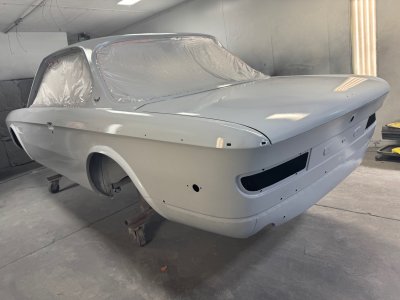
72 3.0 CS 2240344 Restoration

Yeah, same basic pronunciation. I initially called it Eh-Ti-Mow, which is clearly incorrect.

Your dash pieces are beautiful! I'll definitely be finishing mine in satin like that.

So what are the tips and tricks for veneering? Seems there are two tough spots, the inside curves of the forward dash pieces (probably can be dealt with by proper positioning of the vacuum bag), and the tight curves of the cowl edges. Did you soften and pre-bend the veneer for those edges?

Also, does the side wood veneer go over the longitudinal edges, specifically along the lower edge that is exposed? If so was that done by wrapping, or using a second piece? I worry about the veneer cracking along that edge.
 
we used clear satin ... no need to stain it at all. a lot of shout out to @m5bb as he led the effort here ... i just assisted.

the biggest problem with the gauge piece is the holes for the gauges. a vacuum bag will break the veneer by sucking it into the holes. we made some foam plugs with some expanding insulation into spare gauge trims (for the wood panel). we sanded them down and then laid up the veneer over it (no glue over the plugs) and put it in the bag. the end are tough to get them fully turned over - but the ends aren't visible so no worries. moistening the ends of the veneer helped to turn the sharper corners. we trimmed the veneer close to edges so there wasn't too much to splinter. no secondary pieces were used at edges.

the door / side panels were very easy in the bag.

we gave up on the bag for the big curved dash pieces. we used a lot of clamps on top of plates - the end plates were flexible to help hold the curve.

once we got everything laid up, trimmed gently with a dremel tool (little drum sander i believe).
 
we used clear satin ... no need to stain it at all. a lot of shout out to @m5bb as he led the effort here ... i just assisted.

the biggest problem with the gauge piece is the holes for the gauges. a vacuum bag will break the veneer by sucking it into the holes. we made some foam plugs with some expanding insulation into spare gauge trims (for the wood panel). we sanded them down and then laid up the veneer over it (no glue over the plugs) and put it in the bag. the end are tough to get them fully turned over - but the ends aren't visible so no worries. moistening the ends of the veneer helped to turn the sharper corners. we trimmed the veneer close to edges so there wasn't too much to splinter. no secondary pieces were used at edges.

the door / side panels were very easy in the bag.

we gave up on the bag for the big curved dash pieces. we used a lot of clamps on top of plates - the end plates were flexible to help hold the curve.

once we got everything laid up, trimmed gently with a dremel tool (little drum sander i believe).
Interesting. Good advice about the gauge holes! I may do that with the ash tray slots as well. For the curved cowl edges, there is a spray compound that temporarily softens the veneer. I think I’ll use that and bag it with no glue to set the curve, and then remove it, let it dry, maybe with something holding the curve in place, and then bag it with glue
 
we used clear satin ... no need to stain it at all. a lot of shout out to @m5bb as he led the effort here ... i just assisted.

the biggest problem with the gauge piece is the holes for the gauges. a vacuum bag will break the veneer by sucking it into the holes. we made some foam plugs with some expanding insulation into spare gauge trims (for the wood panel). we sanded them down and then laid up the veneer over it (no glue over the plugs) and put it in the bag. the end are tough to get them fully turned over - but the ends aren't visible so no worries. moistening the ends of the veneer helped to turn the sharper corners. we trimmed the veneer close to edges so there wasn't too much to splinter. no secondary pieces were used at edges.

the door / side panels were very easy in the bag.

we gave up on the bag for the big curved dash pieces. we used a lot of clamps on top of plates - the end plates were flexible to help hold the curve.

once we got everything laid up, trimmed gently with a dremel tool (little drum sander i believe).
Interesting. Good advice about the gauge holes! I may do that with the ash tray slots as well.
 
Some little gifts arrived today. A spare M90 motor from a wrecked 1980 Euro 635, and an unopened NOS box of Bosch W9RLS "Silber" plugs (these make the M90 happy).
I'll probably rebuild or trade the M90, since I have a professionally rebuilt one from Don, and the one in Rocinante (my Euro 635) is strong and has matching numbers to the car...

Anyone need a set of Tesla winter wheels? My son gave me his Model Y Performance (he works at Tesla and got a new one), and shipped it to me from Chicago with both sets of wheels.

Screenshot 2026-05-14 at 8.13.13 PM.png

Screenshot 2026-05-14 at 8.13.45 PM.png
 
Last edited:
Progress on the wood...With @TomHom's imminent wood dash arrival, I started work on the other parts. I bought only the two curved dash pieces from Tom. My instrument bezel and side wood are salvageable.

As mentioned above, I was able peel off 99% of the veneer from the instrument bezel (i'll probably sand the rest off), and today I did the same with the side wood. The rear
pieces cleaned up easily. The longer door pieces are more stubborn, but I'm pretty sure I can clean them up. The underlying wood is in good shape on all of these.

So, fairly soon we'll be veneering these. That should be fun..

I'll also be re-making the dash tray. I'll post a detailed thread on that.

tempImage4BtjhS.png
tempImagePAm9AX.png
tempImagebXlYxj.png
 
Does anyone have any thoughts on applying CPES (clear penetrating epoxy sealer) to the non-veneered surfaces of the wood? Seems like that would prevent de-lamination and or warping going forward...
 
Progress on the dash. Spent a couple of hours at the shop stripping veneer. Managed to get one of the door pieces fully stripped. The other (the last piece I need to do) is being difficult. I guess it's time for some heat. The speaker grille cleaned up easily! I ended up removing the back piece so I could strip off the decrepit cloth as well. So that's ready to veneer now.

Rented a truck for Tuesday to run down to Berkeley to pick up my subframes, struts and wheels. Once they are back at the shop I'll disassemble them and send everything out for powder coating

Step by step!

Any thoughts or cautions on powder coating the pedal box and pedals?

tempImageeyTdpU.png

tempImagee5nequ.png
 
Last edited:
So yesterday Don Lawrence and Paul Cain visited my car at the body shop. Had a nice conversation with Paul about what the car needed, and he has given solid instructions to the body guy (Eugene). They will be blasting the entire underside, engine bay, trunk, and exterior of the car to remove the rattle can black paint job (I was expecting that). Other than some specifics on the floor and rocker repairs, the car is deemed "solid" (Yay!!!).

Today I rented a u-Haul van and drove down to Berkeley to pick up the wheels and suspension. Man those are heavy when fully assembled! I pulled the wheels and the struts to make them more manageable, and Eugene helped me load them up. The guys next door at the shop loaned me a rolling rack and helped me unload them. Nice to have friends in the car biz!

Next steps will be to power wash them, disassemble them, and get the main bits powder coated. While that's going on I'll renovate the CV joints and half shafts (I may just replace these... we'll see), brakes, etc. Then I can start re-assembling the suspension using all of the Carl Nelson bits I purchased about 2 years back.

Time is on my side here, since Eugene thinks the car may be done by around September.. (yikes!!), so hopefully it will be drivable about this time next year...

Some pics of the car on its stand, and of the suspension bits back in my shop.


tempImage27OY0M.png
tempImage7WgafU.png
tempImageb1673Q.png
tempImageiSHoX4.png
 
that is great news Scott ... i talked on the phone yesterday with Don + Paul while they were driving around. when you get feedback from guys like that ... you are in great shape.
 
Five engines in that last pic…one M90 in the blue car (Rocinante), two M90s, one on the pallet, and one on a stand under a big bag, the Bronco 302 V8, and the original 3.0 from the E9
 
Scott… if they really get the body done by September that would be record time for a shop around here. Most of them quote about a year and a half.

But you have a really good starting place there.
 
Scott… if they really get the body done by September that would be record time for a shop around here. Most of them quote about a year and a half.

But you have a really good starting place there.
Yeah, his words were "it will be done this year", and then probably late summer or early fall.

Seeing what needs to be done, there is not too much open fabrication (just the passenger side footwell), the rest is cutting out bad panels and welding in replacement panels (front floors, outer rockers, and lower fenders (Thankfully below the edge where the bolt on trim panel goes). So once they get the body blasted (next couple of weeks), the major repair work should go fairly fast. Probably 3-4 weeks of metal work, 4 weeks of leveling, and then 4 weeks of prep and paint...so September is not unrealistic, but maybe somewhat optimistic.

Interior is done. Will pick that up in June.
Motor is done.
I'll be rehabbing the suspension, half shafts, dash, wiring, and window/door mechanisms over the next 3-4 months.
Not sure how long Caliper HQ will take on the brakes.
Need to source a 3.45 LSD diff (probably from Don, after I save up a few more pennies), and have the driveline rebuilt for the 265 trans.

Then about 6 moths of assembly and sorting.

I am expecting sorting out the triple Webers will take some time.

Hope to have it on the road by this time next year.
 
Scott,
Yeah, they did a great job on the PDX Airport. Something this city has gotten right lately.

Just wondering.....3.45 vs. 3.25 diff. What is guiding that choice of ratios? One is more relaxed on the freeway, the other more peppy but not much different than the USA 3.64 ratio.

Thanks for your updates. I am a fan of your build and can't wait to see the finished product!

Mike
 
Last edited:
Scott,
Yeah, they did a great job on the PDX Airport. Something this city has gotten right lately.

Just wondering.....3.45 vs. 3.25 diff. What is guiding that choice of ratios? One is more relaxed on the freeway, the other more peppy but not much different than the USA 3.64 ratio.

Thanks for your updates. I am a fan of your build and can't wait to see the finished product!

Mike
There are really four choices: 3.07. 3.25. 3.45 and 3.64

the actual choice depends the trans.

For a 265 CR, many folks prefer the 3.07, since it does not have a super high ratio top gear.

The 3.07 with a 265 cant even get into 5th below about 85 mph...So this are autobahn gears (although more practical with a high torque M90 engine (this was the standard setup for 1980 Euro 635s).

For coupes running standard engines the 3.07 would be a dog.. way too high geared. 3.64 will give you faster acceleration, but limited top end. The 3.25 and 3.45 appear to be a matter of personal preference. 3.25 will offer lowe r acceleration, but higher top speed vs the opposite for the 3.45.
 
There are really four choices: 3.07. 3.25. 3.45 and 3.64

the actual choice depends the trans.

For a 265 CR, many folks prefer the 3.07, since it does not have a super high ratio top gear.

The 3.07 with a 265 cant even get into 5th below about 85 mph...So this are autobahn gears (although more practical with a high torque M90 engine (this was the standard setup for 1980 Euro 635s).

For coupes running standard engines the 3.07 would be a dog.. way too high geared. 3.64 will give you faster acceleration, but limited top end. The 3.25 and 3.45 appear to be a matter of personal preference. 3.25 will offer lowe r acceleration, but higher top speed vs the opposite for the 3.45.

Scott,
Yeah, they did a great job on the PDX Airport. Something this city has gotten right lately.

Just wondering.....3.45 vs. 3.25 diff. What is guiding that choice of ratios? One is more relaxed on the freeway, the other more peppy but not much different than the USA 3.64 ratio.

Thanks for your updates. I am a fan of your build and can't wait to see the finished product!

Mike
if you want more detailed info, check out the FAQ - https://e9coupe.com/forum/threads/speedometer-and-differential-ratios.35162/
in that thread, there is also speed charts / rpm for 3.25, 3.45 + 3.64 diffs
 
Back
Top