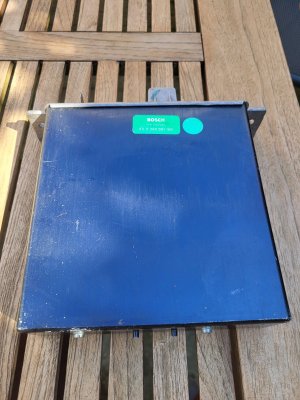
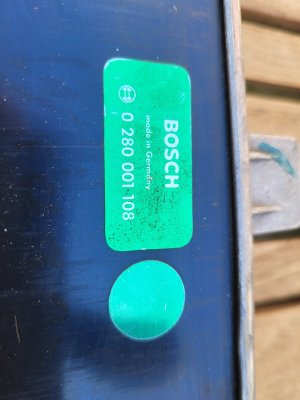
The L-Jet is analog, and pretty simple. There is no ignition control like with Motronic. As you will find reading Probst, basically the concept for L-Jet is to measure the air flow and the air temp (both done in the AFM), and based on that, set the injection duty cycle. The goal here is to meter the fuel to match the number of oxygen molecules. The amount of air depends on the air flow and the air density (temp), and the amount of fuel depends on the duration that the injectors are open. Everything else (idle control valve, throttle position sensor, thermo time sensor, cold start valve, etc.), is all just refinements to handle edge cases.
The L-Jet cars use a Bosch electronic ignition box that gets an engine speed signal from the distributor. I replaced mine with a US made MSD capacitive discharge ignition unit, and big fat MSD plug wires. The MSD has wicked strong spark, and the engine seems to respond well to that. I run (now obsolete) Bosch WR9LS "Silbur" plugs that use a silver electrode.You can usually find them NOS on eBay for about $6 each.
I am not sure if a 123 distributor will fit. If it does, and if it has an engine speed signal output, it might be an interesting upgrade, since the ignition system is otherwise pretty mundane.
For reference, the Motronic system is entirely digital. It uses two crank sensors mounted on the flywheel. One sets the reference for TDC, and the other generates a signal from the flywheel teeth. This essentially creates a clock signal where a single engine cycle (defined by the TDC pulse) is then broken into 58 pulses (actually 60, but they have two missing teeth for some reason). Using that reference, and the same air volume measurement as the L-Jet, they can then adjust the spark as well as the fuel according to a digital engine map (a table of spark advance and injector duty cycles vs engine speed, air flow and air temp). The result is a smoother and more adaptable engine. That said, there is something very visceral and mechanical about the L-Jet M90. Its beauty is that it is NOT refined, it is just strong, like an ox..
I have also found, and @sfdon has confirmed that the M90 does not rev as high as the B35. Fortunately it doesn't need to. Generally the torque comes on at about 1500 RPM, and peaks around 5000, but the variation over that band is fairly small. So you get all that torque early, and it just continues until you shift. It also revs very quickly, probably due to the short rods and short crank throws. The B35 and (especially) the S38 have a rather peaky behavior with peak torque showing up around 3000-3500. As I have written before, the M90 will usually best a B35 or S38 car on twisty roads where the engine rarely gets over 3000 rpm. Above that, and the B35 and S38 will overpower the M90. It also peaks at about 5500 RPM, vs 6000-6500 for the other engines. I am not sure why this is, but with all that low end torque, it is not generally a liability.
I personally like the simplicity of the L-Jet. On my 635, I have to pass the CA emissions test. To do that I have a catalytic converter (which I hope to make removable) and an O2 sensor. Since the ECU has no provision for the O2 sensor input, I developed a circuit that alternately switches in series and shunt resistances to dither the AFM air temp, causing the ECU to dither back and forth around the optimal 14.7:1 Air fuel ratio. SO the system is also fairly adaptable. There are some useful posts on the 528 forum about tuning the AFM as well.
The L-Jet cars use a Bosch electronic ignition box that gets an engine speed signal from the distributor. I replaced mine with a US made MSD capacitive discharge ignition unit, and big fat MSD plug wires. The MSD has wicked strong spark, and the engine seems to respond well to that. I run (now obsolete) Bosch WR9LS "Silbur" plugs that use a silver electrode.You can usually find them NOS on eBay for about $6 each.
I am not sure if a 123 distributor will fit. If it does, and if it has an engine speed signal output, it might be an interesting upgrade, since the ignition system is otherwise pretty mundane.
For reference, the Motronic system is entirely digital. It uses two crank sensors mounted on the flywheel. One sets the reference for TDC, and the other generates a signal from the flywheel teeth. This essentially creates a clock signal where a single engine cycle (defined by the TDC pulse) is then broken into 58 pulses (actually 60, but they have two missing teeth for some reason). Using that reference, and the same air volume measurement as the L-Jet, they can then adjust the spark as well as the fuel according to a digital engine map (a table of spark advance and injector duty cycles vs engine speed, air flow and air temp). The result is a smoother and more adaptable engine. That said, there is something very visceral and mechanical about the L-Jet M90. Its beauty is that it is NOT refined, it is just strong, like an ox..
I have also found, and @sfdon has confirmed that the M90 does not rev as high as the B35. Fortunately it doesn't need to. Generally the torque comes on at about 1500 RPM, and peaks around 5000, but the variation over that band is fairly small. So you get all that torque early, and it just continues until you shift. It also revs very quickly, probably due to the short rods and short crank throws. The B35 and (especially) the S38 have a rather peaky behavior with peak torque showing up around 3000-3500. As I have written before, the M90 will usually best a B35 or S38 car on twisty roads where the engine rarely gets over 3000 rpm. Above that, and the B35 and S38 will overpower the M90. It also peaks at about 5500 RPM, vs 6000-6500 for the other engines. I am not sure why this is, but with all that low end torque, it is not generally a liability.
I personally like the simplicity of the L-Jet. On my 635, I have to pass the CA emissions test. To do that I have a catalytic converter (which I hope to make removable) and an O2 sensor. Since the ECU has no provision for the O2 sensor input, I developed a circuit that alternately switches in series and shunt resistances to dither the AFM air temp, causing the ECU to dither back and forth around the optimal 14.7:1 Air fuel ratio. SO the system is also fairly adaptable. There are some useful posts on the 528 forum about tuning the AFM as well.
Last edited: