Upgrading from Dual Weber 32/36s to Triple 40 DCOEs – What else do I need?

The pic of the coolant lines is great. First I have seen without the carbs blocking the view. Ill scope out the e24 diagrams some more. @boonies lead me down this path recently as well.
Will PM you about the horns, but I think they'll be too long. I am going to try and keep my existing, large diameter brake booster. Ill need the shortest ones they make to make the clearance work.
I just sent you a direct message about the horns and screens you need for the big OEM booster.
 
Hey! While I wait for my new Webers to arrive by snail mail, I have been assembling my parts list and feel like I have most of the essentials mapped out. Keen to get your thoughts and feedback.
View attachment 225502

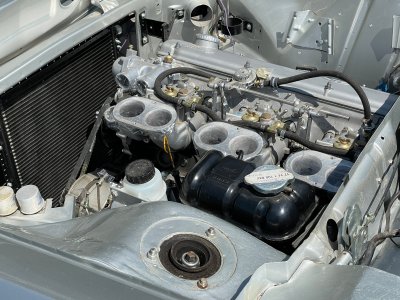
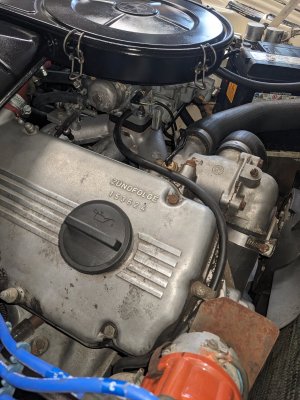
One other thing I have been trying to figure out is how to re-plumb the coolant lines for the triple Webers. Attached are some photos of my DGAV setup and the lines that will need to be sorted (marked with red Xs) Any advice? What have others done?

I have to reroute
* The ~8mm running from the rear bottom of the block up to the rear manifold.
Can this one just to capped off at the block?

* The line running through the firewall to the manifold. Then connecting the two manifolds together and from the front manifold to the T-stat housing
Can this one be looped to complete the circuit? Is so, any parts recommendation?

Also, any recommendations on what to do for a temporary AFR Gauge? Looking for something that could be used during the tuning process and easily removed.

you can PM me or call, I live in Kirkland
 

Attachments

  • my engine cmpt.JPG
    my engine cmpt.JPG
    456.5 KB · Views: 20
I just sent you a direct message about the horns and screens you need for the big OEM booster.
Thanks mate, I have some in the mail that hopefully will work. 1.5in for the front and rear carb and 1in for the middle to clear the larger stock booster for the bavaria.
 
These aren’t very OEM-like but in the ballpark. I had speedhut make me these. I provided the icons, AFR on the far left. What makes them bmw-like is that the dials are white and located in the center. The bezels are bit large and the center spindle cover is a bit plain and shiny. Best I could do though with their options.
Just checked out the Speedhut site. They make direct replacements for the 2002 gauges...too bad nothing for ours.

I like the ability to customize the gauges and am looking at the AFR options there...
 
@mark99 : I see right angle intake headers on your engine photo. Are you planning to use the Alpina intake ?

Your setup looks like these parts up for sale:
 
You mean intake 'horns' as people call them
yes, I have the repo set up from Mark in the UK
I have his plenum and 'horns', I am reusing some manifolds, I had an exchange with Mark and the manifolds I have seem to be the same dimensions as the ones he sells
 
the problem with triple Webers is getting an air filter, I had a 2002 with Webers and the foam things in wire baskets, which I hated, so I was very happy to find this
I did look into several options
 
Until now, I wasn't familiar with the term "horns" (I've heard "trumpets" many times) - and your right angle adapters didn't seem like trumpets to me, so I used manifold, which isn't the proper term...

Thanks for the education and the new term in my lingo. Much appreciated.
 
Last edited:
I think horns sounds strange too, but that is what I have heard them called, and manifold is the part between the carb and the head, I don't know if there is an official term
 
I have researched the role of the trumpets, curved and straight.

The idea here is to create a resonance that induces a wave that forces the air fuel mix into the cylinder. Conceptually the volume of air moving though the carb and the intake ports has some momentum. It hits the closed intake valve, and bounces back, it then hits the outside atmosphere at th end of the intake tube, an bounces back toward the engine. Depending on the length of the intake tube, and the engine speed that wave can create a high pressure at the intake valve when it opens, effectively super charging the intake.

What this means is that you do not want a nice exponential trumpet, but rather a tube that has a bell mount flare on the end to avoid turbulence.

A nice looking exponential trumpet will actually match the reflected wave to the atmosphere, and eliminate the resonant reflection.
 
I have researched the role of the trumpets, curved and straight. The idea here is to create a resonance that induces a wave that forces the air fuel mix into the cylinder. Conceptually the volume of air moving though the carb and the intake ports has some momentum. It hits the closed intake valve, and bounces back, it then hits the outside atmosphere at th end of the intake tube, an bounces back toward the engine. Depending on the length of the intake tube, and the engine speed that wave can create a high pressure at the intake valve when it opens, effectively super charging the intake.

Exactly, "depending on the engine speed". I can understand how tuning the length and shape of the intake path would result in "effectively super charging the intake", but it would seem that this phenomenon would only work at one point in the RPM range. That could be great on a race car, where you want to optimize power at top speed, or coming out of corners, or whichever single RPM level that you chose. But on a street car, where your need for power comes at various RPM levels, I don't see how this effect would be useful. Am I missing something here?
 
Last edited:
Exactly, "depending on the engine speed". I can understand how tuning the length and shape of the intake path would result in "effectively super charging the intake", but it would seem that this phenomenon would only work at one point in the RPM range. That could be great on a race car, where you want to optimize power at top speed, or coming out of corners, or whichever single RPM level that you chose. But on a street car, where your need for power comes at various RPM levels, I don't see how this effect would be useful. Am I missing something here?
For a perfect system, this speed dependency would be the case. My understanding is that because there are multiple resonant modes, the effect gets smeared out over a range of RPMs. In addition, since the trumpets are slightly tapered, this changes the resonant effect from what you would get with a straight tube, and also causes the air column to speed up as it enters the carb.

What I mean by resonant modes is that you can get multiple reflections, which add and subtract at different engine speeds, so there are multiple pressure waves occurring at different frequencies (various fractions of the length from the tube opening to the valve). Consider a tube 150 mm long. Suppose that resonates at 1500 RPM (this is only illustrative). That means that at 3K RPM you will get a second harmonic wave that also peaks at the valve, and a third will occur at 6K RPM.

So the common wisdom is that longer trumpets are better for low end torque, and shorter trumpets are better for higher RPM torque, but the specifics are pretty slippery to be sure!!

The real point is that if you use a true exponential trumpet (which would not fit well anyway) you get a negative effect because you are effectively letting the reflected waves pass out the front of the carb reducing the volume of air coming in.

Here is a somewhat dense paper onthe topic. These guys modeled the flow pattern into the cylinder as the valve opens. They found that, up to a point, the longer intake runner also caused a more efficient swirl of the mixture in the cylinder, which was, to me, and interesting result. Unclear how much of the torque effect is from pressure and how much is simply a more efficient flow. Their dyno graphs are interesting. They show a clear increase in low end torque from longer tubes.
 

Attachments

Last edited:
Back
Top