Car lift for a home garage use.

Atlas four-post with extended height
I have the same lift. Note the loose cables. Once when my cables were loose one came off one of the pulleys. I didn’t notice and when I operated the ram, that cable got wedged tight between the pulley and cross bar and caused one ramp to tilt significantly. It was a b*tch to get it unstuck as I had to lift the tilted ramp with an house Jack (adjustable lally column) before I could pry the cable back in place. Now, when the lift is on the stops I only release the pressure enough to take most but not all the tension off the cables.
 
Last edited:
I have the same lift. Note the loose cables. Once when my cables were loose one came off one of the pulleys. I didn’t notice and when I operated the ram, that cable got wedged tight between the pulley and cross bar and caused one ramp to tilt significantly. It was a b*tch to get it unstuck as I had to lift the tilted ramp with an house Jack (adjustable lally column) before I could pry the cable back in place. Now, when the lift is on the stops I only release the pressure enough to take most but not all the tension off the cables.

This happened to me once or twice as well. The cables will jump off a pulley and bind with the next cable over. I forget how I finagled it, but I did get the cable back on the pulley. The mfr does request full slack in the cables (and retraction of the hydraulic piston rod) when the safety locks are engaged, but I think this is just overkill.
 
This happened to me once or twice as well. The cables will jump off a pulley and bind with the next cable over. I forget how I finagled it, but I did get the cable back on the pulley. The mfr does request full slack in the cables (and retraction of the hydraulic piston rod) when the safety locks are engaged, but I think this is just overkill.
This is good to know about full slack/cables slipping. I have the same 4 post lift (well, not the extended height) and I usually rest on the safety locks and then bump the cables to have a little bit of tension on them.
 
This is really good info. Did the cables jump when the lift was up or when it was all the way down?
For me it was at the top position. The cable bound up when I tried to raise it off the safety stop. Idiot that I am I didn’t notice this until I started lowering, and noticed one ramp was cockeyed by 10”. Was glad to have decent wheel chocks in place.
 
For me it was at the top position. The cable bound up when I tried to raise it off the safety stop. Idiot that I am I didn’t notice this until I started lowering, and noticed one ramp was cockeyed by 10”. Was glad to have decent wheel chocks in place.
Thanks John for letting me learn from your experiences. I just went out and tightened the cables.
 
For me it was at the top position. The cable bound up when I tried to raise it off the safety stop. Idiot that I am I didn’t notice this until I started lowering, and noticed one ramp was cockeyed by 10”. Was glad to have decent wheel chocks in place.
I wonder if it would be worthwhile to put in a cable tensioner to take up the slack, something with a spring-loaded swing arm to not let the cables come off the pulleys. I have a hydraulic two post lift, so it's not something I've had to worry about.
 
This is good to know about full slack/cables slipping. I have the same 4 post lift (well, not the extended height) and I usually rest on the safety locks and then bump the cables to have a little bit of tension on them.
The other thing to watch with four-posters is leveling the corners. At least with Atlas, if the posts are not REALLY close to level (meaning the two at the door end adjusted UP for the pitch of your garage floor), it's possible for the locking extensions to, um, misinterpret their resting points and for one corner to drop an extra notch. With a bang. Even with my big wrench/socket and patience, I still had to call back a professional troubleshooter to fine-tune. I've also learned not to sweat (too much) the plumbness of each post, although I do check from time to time. They will lean an inch or so as a vehicle goes up and down. This could also be an effect of my unit not being anchored to the floor, now that I think about it.
 
The other thing to watch with four-posters is leveling the corners. At least with Atlas, if the posts are not REALLY close to level (meaning the two at the door end adjusted UP for the pitch of your garage floor), it's possible for the locking extensions to, um, misinterpret their resting points and for one corner to drop an extra notch. With a bang. Even with my big wrench/socket and patience, I still had to call back a professional troubleshooter to fine-tune. I've also learned not to sweat (too much) the plumbness of each post, although I do check from time to time. They will lean an inch or so as a vehicle goes up and down. This could also be an effect of my unit not being anchored to the floor, now that I think about it.
Ya know, I’ve noticed some sway with mine. Minor, but I notice it at times when raising a vehicle up. Mine isn’t bolted down but I am certainly leaning that way now. My floor is as level as it will ever be. The slab was poured probably 14 years ago. The last thing I want is for the locking extensions to…misinterpret their resting points. Now that’s a scary one. Good looking out!
 
I do find it a little concerning that the 4 posts are not bolted down. I even have a caster kit with the lift that I will never use. I will probably bolt it down eventually.
 
I do find it a little concerning that the 4 posts are not bolted down. I even have a caster kit with the lift that I will never use. I will probably bolt it down eventually.
I have 2 4-post lifts which aren't bolted to the floor. Have had zero issues with this for over 10 years now.
 
My 4-post lift is not bolted down. Has lifted both my Mustang and now the E23. Very stable. No concerns.....
 
Last edited:
I do find it a little concerning that the 4 posts are not bolted down. I even have a caster kit with the lift that I will never use. I will probably bolt it down eventually.
It's really a non-issue; Atlas even notes that it's optional. I did put some rubber exercise-floor material underneath each post foot since I did notice the lift "walking" a small amount after a few ups and downs. My pebbled epoxied floor is the main issue for that. A concrete or even smooth painted surface--it shouldn't move at all. It's substantial.
 
The other thing to watch with four-posters is leveling the corners. At least with Atlas, if the posts are not REALLY close to level (meaning the two at the door end adjusted UP for the pitch of your garage floor), it's possible for the locking extensions to, um, misinterpret their resting points and for one corner to drop an extra notch. With a bang. Even with my big wrench/socket and patience, I still had to call back a professional troubleshooter to fine-tune. I've also learned not to sweat (too much) the plumbness of each post, although I do check from time to time. They will lean an inch or so as a vehicle goes up and down. This could also be an effect of my unit not being anchored to the floor, now that I think about it.
I have a Rotary Solutions 8000 lb four post lift and the installation procedure doesn't call for leveling the corners of my lift. Instead, you first adjust the latch bars within each tower so that the deck is level when the deck is in the locked position, and then set the cables so that the lift is level when the deck is hanging on the cables. For both of these adjustments, you actually check level on both the runways and on the yoke assemblies/cross bars between the runways so there is a little back and forth in the process. If the floor is not completely level (mine is not), you need more adjustments on the towers sitting on the lower parts of the floor.

My lift does not move. One of the towers will exhibit a tiny tilt when unloaded, but it squares back up when I begin to raise the deck.
 
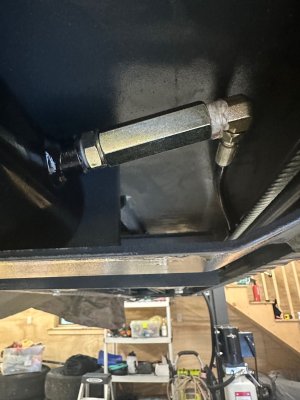
I'm in the same camp as Chris. I have a 7000lb AMGO 4 post lift, and bought it a year and a half ago. I have a nice flat concrete floor, and the installer told me I am better off not bolting it to the floor. So I didn't. No issues in that regard. The issues I have had are that a hydraulic connector under the ramp keeps leaking (weak seals) and needing replacement. I have it replaced twice in the year and half of service. Though replaced under warranty, they told me this part comes from "offshore" and "fails frequently." Not very reassuring, especially since i have used the lift maybe 20 times in total. The other issue is the locking release hangs up on one post, making for an instable lift, which is a real problem. They have been to fix it once, and I am just wondering when the latch breaks again. So bottom line, I would find a lift that is truly made in America. Hope this helps!
 

Attachments

  • Lift Part.jpg
    Lift Part.jpg
    227.5 KB · Views: 12
I do find it a little concerning that the 4 posts are not bolted down. I even have a caster kit with the lift that I will never use. I will probably bolt it down eventually.
I have used the Atlas 4 post for over 2 years and I haven't bolted it down with no issues. My previous concern was unwarranted.
 
I have had my 4 post now for about 6 years and it is not bolted down. Has worked great (I have not moved it to test its portability, but - so far, so good)
 
Back
Top