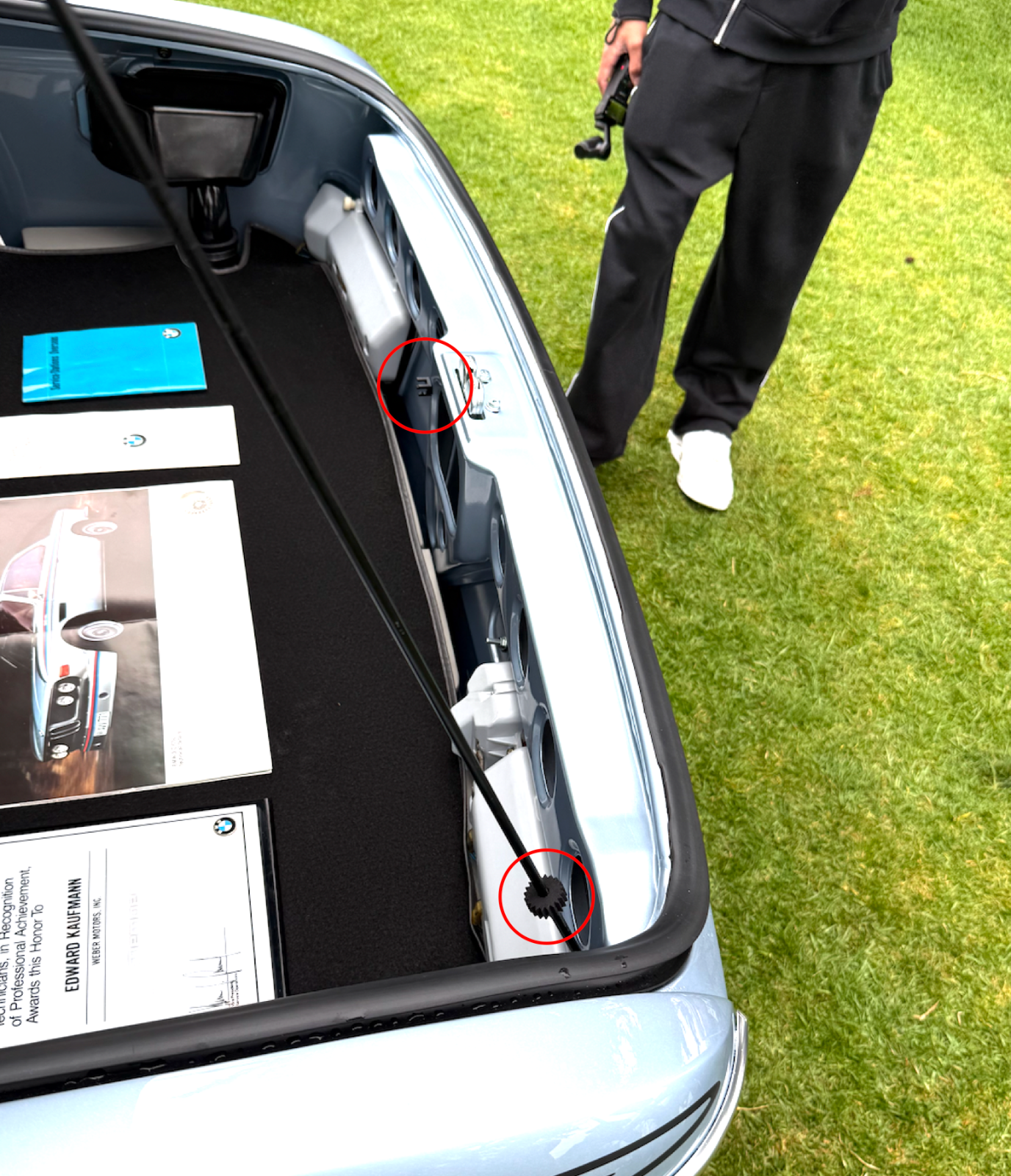
72 3.0 CS 2240344 Restoration

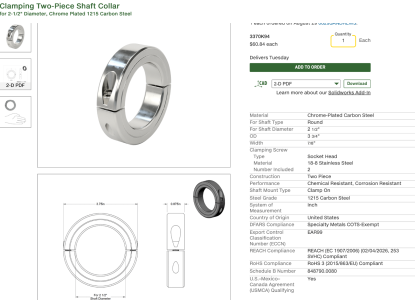
And I am proud to have contributed two eensty weentsy little parts to this effort.
Screenshot 2026-08-13 at 10.35.12 PM.png


Truly a beautiful car...
 
Question for the hive mind...

I am ready to refinish my suspension parts.

Subframes are empty and cleaned, trailing arms are disassembled, strut tubes are disassembled, etc.

I am wondering about two interrelated questions:

1) Is it better to paint these parts using 2K primer and 2K satin black paint, or should I powder coat them?

2) If I powder coat them, how to I make sure they are masked off in the right places (spindles, strut to knuckle, caliper mounts, strut tube threads, bushing holes, ball joint holes, etc...)?

I know many folks do powder coat, but it seems that you have to leave a lot to the powder coater who will blast them, clean them, and hopefully mask the right spots prior to coating...not sure how much I trust them to do that properly...

And then there is the question if the power coating gets chipped or is improperly adhered in some spot, does that create a potential rust haven? Seems like pain maybe easier to deal with..

Thoughts?
 
I would think that the powder coater would know their stuff, but one option would be for you to mask off what you don’t want coated and take a picture of each area which you print out and give them with the part. “Blast it, mask it off as per these pictures and coat the rest” will be your instructions
 
I would think that the powder coater would know their stuff, but one option would be for you to mask off what you don’t want coated and take a picture of each area which you print out and give them with the part. “Blast it, mask it off as per these pictures and coat the rest” will be your instructions
Yeah, that might work. I think the proper way to prep them is probably a metal dipping process. Alkaline, acid, wash, passivate.. I found a local place that does that, and I think the powder coater also does it. So maybe I can do as you say, and then go inspect them before they coat them, to be sure they have masked everything that needs masking.

I am assuming most metal mating surfaces would not get coated...
 
An auto painter who doesn't mask mounting holes isn't a real painter...
Any reputable painter—whether working with traditional paint or powder coating—is obliged to plug and protect all mounting holes and threads.
Powder coating is far more durable than standard paint finishes.
Coating defects or chips can be touched up and corrected, but the fix won't be permanent.
If the budget allows, one might consider Cerakote technology.
 
I had the front sub-frame powder coated and really had only two areas of concern on re-assembly. The first was the rubber mounting for the tension strut (#5 in the picture below). I did not ask them to tape the area and had a hell of a time getting the rubber back in. It is notoriously difficult and I could not get it installed, I ended up with a polyurethane / Delrin bushing instead and while I try to stay away from them it has been fine.

The second area that caused an "issue" was the spreader (#12) in the picture below. The clearance was too tight and I scratched the finish on installation. I was concerned that the tab for the sway bar was going to be too tight, but it was fine.


1786807656230.png
 
Forget powder. Use a heat cured cerakote. It was developed for rifle barrels. Amazingly hard. Doesn't chip. The coating is so thin that you don't have to mask or tape anything. The entire part gets coated. Both of my best powder coasters over the years have switched to Cerakote. Powder offers more color options but for most stuff it doesn't matter. Can also fill pits with JB weld,sand and recoat.
 
Forget powder. Use a heat cured cerakote. It was developed for rifle barrels. Amazingly hard. Doesn't chip. The coating is so thin that you don't have to mask or tape anything. The entire part gets coated. Both of my best powder coasters over the years have switched to Cerakote. Powder offers more color options but for most stuff it doesn't matter. Can also fill pits with JB weld,sand and recoat.
Looks like a good solution! I was going to Cerakote my headers, but looks like I should just do everything in that.
 
The heat cured is the way to go. Air cured is nice but no where near as durable. We only use that if the part can't be baked in the oven. It's really sweet to assemble something that has not been powder coated.
 
I'm surprised Cerakote hasn't become more ubiquitous in various industries. It's really amazing stuff, and not much harder to prep for compared to paint or powder.

I don't have a blast cabinet, so my surface prep at home is a compromise. Despite that, I've had really great results coating everything from hardware to hard parts. I've had a similar experience as Rudy with the air vs. oven cure. My scientific oven @ home is only ~16"x16"x16", so the larger stuff needs to be air cured, or outsourced to a local shop.
 
Off topic;

My son, who works at Tesla, recently gave me his 2022 Model Y (He got a newer one). We shipped it to Austin TX where we have place to stay when visiting the grandkids (which my wife Susan does regularly). Anyway, we have been here for about 10 days using the car to pick up kids from school and such, in those busy days before the school year starts.

Today Susan was picking up one of the boys and when she opened the car the doors made a weird noise. She got in the car and it was dead.. as in zippo response. She called, I went online and we tried all of the suggested fixes...numerous non-intuitive steps like push and hold the brake pedal, push the two scroll knobs at the same time, etc, etc.. Nada... Zilch...

After some calls to Tesla, and AAA we determined that the 12 volt battery had died.

I suggested she just leave the car and call an Uber, but she pointed out that since normally the windows roll down slightly when the doors open or close, and since they were up, the doors would not close.. WhoTF makes a car that you cannot secure even if the battery is dead???? Apparently the software obsessed geeks at Tesla do...

The AAA guy showed up after 2 hours, and apparently did not have a jumper cable or a battery pack (WTF? again). The service center was now at closing time.. A friend who also has a Tesla went to an auto parts store and got a battery jumper pack, and went over to the car. Apparently this is a thing with Teslas.. you pop open the tow hook port and there are a couple of wires that you can hook to a power source to pop open the"frunk", which then gives you access to the 12 volt battery.

They then hooked up the booster pack to the battery and the car booted up, the windows responded so we could both close the doors and drive the car.. We'll have the battery replaced sometime next week, since we are off to Chicago tomorrow AM early.

The core issue that boils my blood here is who on earth would design a car that you cannot close and lock the doors on if the battery dies? This car is a magnum opus of electronic control of everything, but the problem with that is that if anything goes wrong the car is a dead brick. If not for our friend, my wife would have had to leave the car in a parking lot overnight with the doors open (not unlocked, OPEN), until after changing our flights we managed to get a service person there to address the issue.

As soon as this car is functioning again, I am selling it and getting another Audi. MY 2007 Audi never failed to do anything ...I gave it to a relative in 2018. My 2018 Audi has been flawless ever since. I'm taking it to Austin to replace this POS Tesla, and I'll get a new Audi to drive at home...

There is definitely a boundary of too much reliance on electronics, and once crossed beware!!!
 
My wife has a 2018 model S. The key fob battery was at the end of life (it didn't notify ahead of time) and while she was back at the car after an activity the alarm triggered with horns blowing and the stereo playing classical music at full blast. She has had it, I am now under orders to sell it.

She really likes plugging it in at the house rather than stopping at the gas station (keep in mind that +/- 95% of the time I filled her cars up for her), but she is not a fan of the almost complete lack of physical controls, everything is accessed from the touch screen.

By the way, I have a 2018 Audi Q7. Last week it notified me on the dash that it was time to replace the key fob battery...
 
Apparently the latest version of this car has no control stick either. Instead of flipping the lever to go forward or back, you swipe on the touch screen. Sounds like a very bad idea...

I have worked in the auto industry since the early 1990's. Almost every safety critical system either has some mechanical backup, or it has internal redundancy, so if anything fails, it either fails safe, or it continues to work and warns you that it needs service. I did an electric power steering system in the early 1990's. It used a ball-screw rack, and just added torque boost to the already mechanical linkage, so if the motor or the drive electronics failed, you could still steer the car.

I also did a touch based interface for Ford back in the early 1990's. That was interesting since I experimented with a mouse, a track ball, and a touch screen before landing on a touch pad that had tactile regions that corresponded to selectors on the screen. So, you could control the selectors on the screen by simply touching the corresponding area on the touch pad in the center arm rest console. Easy to grasp, and easy to control because your hand is not bouncing around as you try to hit a target on the screen that is also bouncing around.. (I am reluctant to part with my 2018 Audi for this reason, the newer models use a touch screen, and it suffers from this same issue - one that has been known for 30+ years!)

My Audi has a very convenient, touch based lock/unlock feature on the exterior door handles..but the key fob still has a tiny manual key to be used in case something in that electronic system fails...and yes, it also warns me when the fob battery is low...

From the first day I drove the Model Y I was non-plussed. Harsh ride, harsh regen braking with no way to adjust it, non-intuitive controls, simple things buried 2 -3 layers deep in a touch screen menu... and that nice super clean dash with air vent controls set one layer into the menu screen using a touch and pinch gesture, so you can no longer just twiddle the vent to what you want.. you twiddle the screen and see how that feels, and then twiddle some more... because there is only a conceptual linkage between what is shown on the screen and what is actually blowing at your face...Too much software with too little thought given to how people operate...

Tesla seems to be headed down a dark overly software focused approach developed by geeks that probably don't even own a car, and apparently never heard of FMEA...
 
Back
Top